
How to Fix a Muddy Yard in Watauga County: A High Country Drainage Guide
It seems contradictory that Watauga County is currently facing an exceptional drought with rainfall totals more than 21 inches below average, yet your backyard remains a saturated mess after a single afternoon shower. You're likely tired of the constant cycle: pets tracking heavy clay into the house, grass dying on sloped areas, and standing water that simply won't budge. When the local Watauga series soil becomes compacted, even a small amount of moisture can turn a functional landscape into a messy liability. Knowing how to fix a muddy yard in Watauga County requires a strategic approach that addresses the unique drainage challenges of our High Country terrain.
We understand that maintaining a dry and stable property is essential for your peace of mind and long-term property value. This guide provides professional techniques and identifies the specific bulk materials, such as ABC stone, river rock, and hardwood mulch, needed to transform your soggy landscape into a dependable outdoor space. You'll learn how to master erosion control on steep grades and stay informed about the 2026 updates to local watershed and soil erosion ordinances. By focusing on effective resource management and the right physical tools, you can ensure your yard remains walkable and functional regardless of the weather cycle.
Key Takeaways
Identify why Watauga's heavy clay soil and high annual precipitation require specialized drainage strategies beyond simple surface cover.
Learn how to fix a muddy yard in Watauga County by applying heavy hardwood mulch to stabilize high-traffic zones and prevent pets from tracking mud indoors.
Establish a permanent drainage framework using ABC stone for structural stability and river rock for functional, decorative water management.
Improve long-term soil health by incorporating bulk compost and premium topsoil to facilitate better water infiltration and support healthy turf growth.
Navigate the logistical challenges of bulk material procurement in the High Country to ensure reliable delivery to even the most remote mountain sites.
Understanding the 'High Country Mud' Problem in Watauga County
High Country mud isn't a standard landscaping issue; it's an operational challenge created by the intersection of unique geology and mountain weather. Watauga County properties often face saturated clay that holds water for days, creating a slurry that swallows grass and makes outdoor spaces unusable. Understanding how to fix a muddy yard in Watauga County begins with recognizing that our local soil doesn't behave like the sandy loam found in lower elevations. Instead, we deal with a combination of high moisture retention and steep grades that require a strategic approach to manage effectively.
The Role of Watauga County Soil Composition
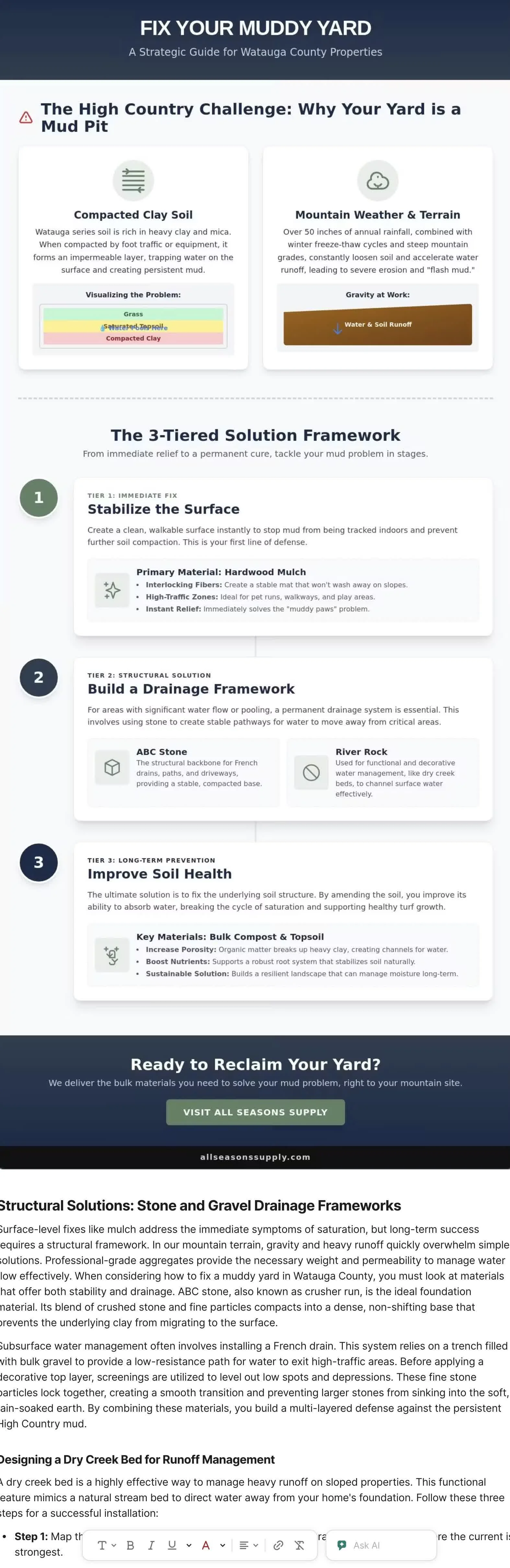
The dominant soil types in our region, specifically the Watauga series, are rich in clay and mica. While these soils are deep and well-drained in their natural state, they're prone to extreme moisture retention when disturbed or compacted. Clay particles are microscopic and pack together tightly, leaving little room for water to move downward. When foot traffic or heavy equipment crosses these damp areas, the soil compacts even further. This creates an impermeable layer that forces water to sit on the surface. Before you choose a specific bulk material, perform a simple percolation test to see how long it takes for a dug hole to drain. This data helps determine if you need surface stabilization or a structural solution like a French drain to redirect subsurface water away from high-traffic zones.
Weather Factors: Rainfall, Snowmelt, and the Freeze-Thaw Cycle
Weather in Boone and surrounding areas is relentless. We receive over 50 inches of annual rainfall, often delivered in high-intensity bursts during the summer months. These storms create "flash mud" on exposed slopes, where water gains enough velocity to strip away topsoil and deposit it in low-lying areas. Winter adds another layer of complexity with the freeze-thaw cycle. As groundwater freezes, it expands and heaves the soil, breaking apart established root systems and loosening the earth. When the spring thaw arrives, this loosened soil combines with melting snow to create deep, unstable mud pits that can persist for weeks.
Steep mountain grades accelerate these issues significantly. Gravity pulls water and sediment downhill, creating muddy runoff zones at the base of slopes or against foundation walls. Effective management requires a year-round strategy. You can't wait for a dry spell to address these problems, as the damage to your soil structure is often cumulative. Knowing how to fix a muddy yard in Watauga County means preparing your property for the High Country's extreme moisture cycles using stable bulk materials like ABC stone or heavy hardwood mulch to break the cycle of erosion and saturation.
Immediate Fixes: Using Bulk Mulch to Cover and Stabilize Mud
While structural drainage systems are the long-term goal, immediate relief is often necessary to stop mud from entering your home. Hardwood mulch provides an effective barrier that stabilizes the surface while you plan more permanent installations. Understanding how to fix a muddy yard in Watauga County often begins with selecting a material that can withstand our specific topography and weather patterns. Shredded varieties are particularly effective because they provide a textured surface that improves traction for both residents and pets.
For many property owners, the primary motivation for an immediate fix is the frustration of "muddy paws" and debris tracked into the house. Applying a thick layer of designer brown or black mulch in high-traffic pet zones creates a clean, walkable surface that separates the mud from the traffic. This approach doesn't just improve aesthetics; it provides a strategic layer of protection that prevents further soil compaction and erosion during the rainy season.
Choosing the Right Mulch for High Country Slopes
Shredded hardwood mulch is the industry standard for mud control on uneven terrain. Unlike pine nuggets, which are light and prone to floating away during heavy rainfall, hardwood fibers interlock or "knit" together. This creates a dense mat that remains stable on the steep inclines common in the High Country. For areas dedicated to children's play, playground mulch offers a softer, high-impact surface that drains quickly. Pine straw remains a viable option for decorative garden beds where foot traffic is minimal, but it lacks the weight needed to suppress deep mud in high-use zones. When you need to stabilize a large area quickly, securing a bulk hardwood mulch delivery ensures you have the volume required for consistent coverage.
Application Tips for Long-Lasting Results
To achieve effective stabilization, you must apply mulch at a depth of 3 to 4 inches. This thickness provides enough volume to absorb surface moisture and prevent soil from churning upward. If the layer is too thin, the underlying clay will eventually mix with the mulch, creating a messy slurry. Conversely, you must avoid piling material directly against tree trunks or plant stems, as this can trap excessive moisture and encourage rot.
Remove large debris and level the area as much as possible before application to ensure the mulch makes direct contact with the soil.
Focus on established paths and entryways first to create a clean transition into the home.
Refresh the top inch of mulch annually to maintain its color and effectiveness against the High Country's freeze-thaw cycles.
Ordering bulk materials is significantly more cost-effective and efficient than purchasing individual bags for large muddy areas.
Structural Solutions: Stone and Gravel Drainage Frameworks
Surface-level fixes like mulch address the immediate symptoms of saturation, but long-term success requires a structural framework. In our mountain terrain, gravity and heavy runoff quickly overwhelm simple solutions. Professional-grade aggregates provide the necessary weight and permeability to manage water flow effectively. When considering how to fix a muddy yard in Watauga County, you must look at materials that offer both stability and drainage. ABC stone, often referred to as crusher run, serves as the ideal foundation. Its blend of crushed stone and fine particles compacts into a dense, non-shifting base that prevents the underlying clay from migrating to the surface.
Subsurface water management often involves the installation of a French drain. This system relies on a trench filled with bulk gravel to provide a low-resistance path for water to exit high-traffic areas. Before applying a decorative top layer, screenings are utilized to level out low spots and depressions. These fine stone particles lock together, creating a smooth transition and preventing larger stones from sinking into the soft, rain-soaked earth. By using a combination of these materials, you build a multi-layered defense against the persistent High Country mud.
Designing a Dry Creek Bed for Runoff Management
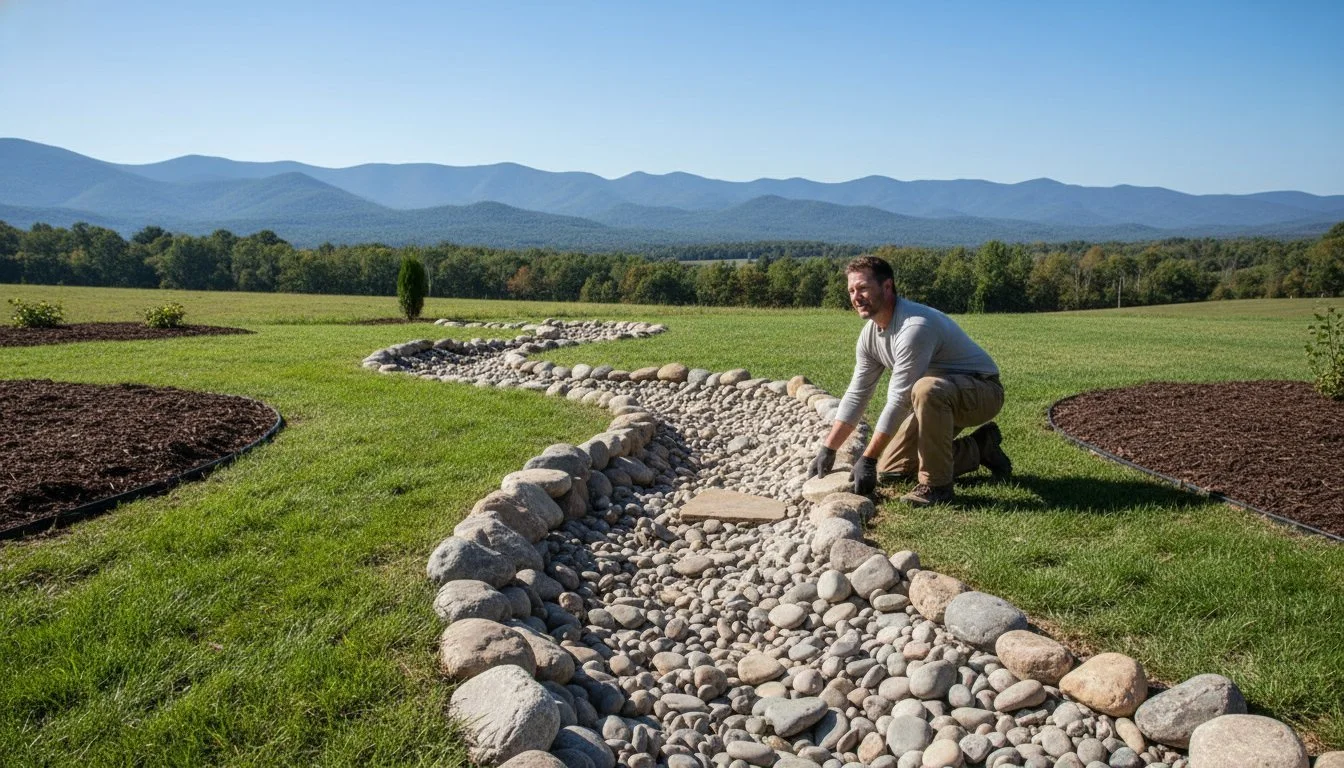
A dry creek bed is a highly effective way to manage heavy runoff on sloped properties. This functional feature mimics a natural stream bed to direct water away from your home's foundation. Follow these three steps for a successful installation:
Step 1: Map the natural path of water during a typical Watauga rainstorm to identify where the current is strongest.
Step 2: Excavate a shallow, meandering trench along this path and line it with heavy-duty landscape fabric to prevent soil mixing.
Step 3: Fill the trench with a strategic mix of large river rock for structural weight and smaller pea gravel to fill the gaps, creating a natural appearance that handles high-velocity water.
The Best Stone for High Country Walkways
Choosing the right walking surface is critical for maintaining a mud-free property. For formal paths, flagstone and fieldstone offer a stable and aesthetically pleasing solution that won't wash away in a storm. While these larger stones provide the walking surface, ABC stone remains the industry standard for driveways and heavy-use utility paths because of its superior compaction. To ensure your walkway remains level over time, use screenings to lock the larger stones in place. This prevents shifting during the freeze-thaw cycles and ensures that your strategy for how to fix a muddy yard in Watauga County remains effective for years to come.
Long-Term Prevention: Soil Health and Erosion Control
While stone and mulch provide immediate stabilization, long-term success involves changing the physical properties of the soil itself. If you want to know how to fix a muddy yard in Watauga County permanently, you must address the underlying clay density. Heavy clay lacks the internal architecture needed for water to move vertically. By introducing organic matter, you create a more porous environment that supports both drainage and plant health. This biological approach works in tandem with structural stone frameworks to ensure your property handles moisture efficiently year after year.
Establishing a thick, healthy turf is one of the most effective ways to prevent surface mud. Grass roots act as a natural mesh that holds soil particles in place, while the blades dissipate the energy of falling rain. However, grass cannot thrive in compacted, anaerobic clay. Providing a foundation of high-quality topsoil allows root systems to penetrate deeper, making the lawn more resilient to foot traffic and heavy weather cycles. Ground covers also play a critical role by protecting exposed soil on steep inclines where traditional grass might struggle to take hold.
Amending Watauga Clay with Compost and Topsoil
Mixing high-quality compost into the existing clay is the most effective way to create "pore space." This process breaks the cohesive bonds of the clay particles, allowing water to infiltrate rather than pool on the surface. For establishing new lawn areas or revitalizing thin spots, a blend of approximately 70% topsoil and 30% compost provides the ideal ratio for a stable, nutrient-rich base. Fall is the optimal time for these amendments in the High Country. The cooler temperatures allow the organic matter to integrate into the soil profile before the spring thaw brings the next wave of saturation. Securing bulk topsoil and compost ensures you have the volume necessary to treat large sections of your property at once.
Planting for Erosion Control on Slopes
Vegetation acts as a living drainage system on the steep grades common in Boone and surrounding areas. Deep-rooted shrubs, such as native viburnums or mountain laurels, anchor the soil and prevent the top layers from sliding during heavy downpours. Perennials like ferns or sedges thrive in soggy low spots, acting as biological sponges that pull moisture from the earth and facilitate evaporation. A well-planted buffer strip consisting of dense perennials and shrubs can effectively intercept runoff and stop mud from reaching your patio. By selecting hardy nursery trees and shrubs that are adapted to the High Country climate, you create a self-sustaining system that manages water naturally. To start your soil improvement project today, browse our selection of bulk amendments and nursery stock.
Sourcing Bulk Materials in the High Country
Navigating the geography of the Blue Ridge Mountains requires specialized equipment and deep local knowledge. When you're determining how to fix a muddy yard in Watauga County, the quality of your materials is only half the battle; the other half is getting those materials to your site safely and efficiently. Remote mountain properties often present logistical hurdles like narrow, winding gravel roads and steep driveway inclines that standard delivery trucks simply can't manage. We prioritize operational continuity for our clients by maintaining a fleet capable of reaching these difficult locations, ensuring your project stays on schedule regardless of your property's elevation or accessibility.
All Seasons Supply serves as a dependable partner for both independent homeowners and professional contractors throughout the region. As a family-owned business, we understand that seasonal cycles in the High Country are tight and often unpredictable. Our role is to act as the industrious partner working in the background to ensure you have the right physical tools, whether that's ABC stone for a stable base or designer mulch for surface control. We focus on clear communication and practical solutions, moving you from the frustration of a saturated landscape to a concrete resolution with minimal friction.
Bulk Delivery to Boone, Blowing Rock, and Beyond
Our service range extends across Watauga, Avery, and Ashe Counties, providing a comprehensive resource for the entire High Country region. When you schedule a delivery, you can expect a professional assessment of your drop-off site to prevent damage to existing structures or soft turf. It's best to plan your seasonal landscaping deliveries early, especially during the spring thaw when demand for drainage materials peaks. By coordinating your bulk mulch or stone needs in advance, you avoid the logistical bottlenecks that often occur during the busiest maintenance windows of the year.
Delivery Range: We provide reliable transport of bulk materials to job sites and residential properties in Watauga, Avery, and Ashe Counties.
Site Preparation: Ensure your delivery zone is clear of overhead branches and power lines to allow for safe tailgating or dumping of materials.
Volume Efficiency: Bulk delivery is the most cost-effective method for large-scale drainage projects, reducing the waste and labor associated with bagged goods.
Expert Consultations for Your Muddy Yard Project
Experience is a valuable asset when dealing with complex drainage issues. Our team leverages over 50 years of combined industry expertise to provide straightforward advice on material selection. We don't just sell products; we help you match the specific aggregate or soil amendment to your property's unique topography and soil composition. This individualized attention ensures that your investment in how to fix a muddy yard in Watauga County produces lasting results rather than temporary fixes. Contact us today for a quote on bulk material delivery and let us help you secure the resources needed for a dry, functional outdoor space.
Secure Your Landscape Against High Country Moisture
Managing a property in the Blue Ridge Mountains requires a shift from reactive fixes to proactive resource management. You've seen that solving the mud problem involves a three-tiered strategy: immediate surface stabilization with interlocking hardwood mulch, structural water redirection using ABC stone, and long-term soil amendment with bulk compost. Mastering how to fix a muddy yard in Watauga County is about choosing the right physical tools for our specific clay-heavy terrain. By addressing the soil structure and surface permeability together, you create a property that remains stable regardless of the weather cycle.
All Seasons Supply has served Boone, Blowing Rock, and the broader High Country since 2019. Our team leverages over 50 years of combined experience to ensure you receive the most effective materials for your unique site conditions. We maintain a comprehensive inventory of bulk stone, designer mulch, and nursery stock to support your project's success. Order Bulk Mulch and Stone for Your Watauga County Yard Project Today to secure your landscape for the next season. With the right materials and a methodical plan, you can maintain a dry, functional outdoor space throughout the year.
Frequently Asked Questions
What is the best mulch for a muddy yard with dogs in Watauga County?
Hardwood mulch is the superior choice for high-traffic pet areas because its shredded fibers interlock to form a dense, stable mat. Unlike light pine nuggets that float away, hardwood mulch stays in place during heavy rain. This material provides a clean barrier between your dog's paws and the underlying clay, which significantly reduces the amount of mud tracked into your home during wet cycles.
Can I just put gravel over mud to fix my yard?
Simply pouring gravel over deep mud is a temporary measure that often fails as the heavy stone eventually sinks into the soft clay. For a lasting solution, you should first remove the saturated top layer or establish a structural base using ABC stone. Applying landscape fabric before your stone layer can also prevent the materials from mixing and maintain the integrity of your drainage framework.
How much mulch or stone do I need to cover a large muddy area?
You can determine the required volume by multiplying the square footage of your area by the desired depth in feet. For effective stabilization, we recommend a depth of 3 to 4 inches for mulch and 2 to 4 inches for stone aggregates. Ordering bulk materials is the most efficient way to ensure you have the necessary quantity for consistent coverage across large or uneven sections of your property.
What is ABC stone and why is it used for drainage in the High Country?
ABC stone, also known as crusher run, is a specific mixture of crushed stone and fine particles designed to compact into a solid, non-shifting surface. It's the industry standard in the High Country for creating stable driveway bases and utility paths. This high level of compaction prevents water from pooling on the surface and keeps the underlying soil from churning upward into a slurry.
Will planting more grass fix my muddy yard problem?
Planting grass is rarely a standalone solution if you're dealing with severe compaction or poor drainage. If the soil is heavy clay, new seed will struggle to establish deep roots and may simply wash away in the next storm. You must first address the soil structure by mixing in bulk compost and topsoil to ensure the ground can actually absorb water rather than just shedding it.
How do I stop mud from washing down my sloped driveway in Boone?
Stabilizing a sloped driveway in Boone requires heavy, interlocking aggregates like ABC stone that won't migrate downhill under pressure. You can also install dry creek beds using river rock along the edges of the drive to intercept and redirect high-velocity runoff. This combination of structural stone and clear drainage paths prevents rainwater from stripping away your surface material and creating muddy ruts.
Does All Seasons Supply deliver bulk materials to Beech Mountain or Banner Elk?
All Seasons Supply provides reliable bulk delivery to Beech Mountain, Banner Elk, and throughout Watauga, Avery, and Ashe Counties. We specialize in navigating the logistical challenges of remote mountain sites and steep, narrow inclines. Our team ensures that your mulch, stone, or soil arrives safely and is placed in the most functional location for your project requirements.
Is it better to fix a muddy yard in the spring or the fall?
Fall is generally the ideal time for soil amendments and establishing new turf, but spring is the most critical time for immediate stabilization. Addressing how to fix a muddy yard in Watauga County before the heavy spring rains and snowmelt prevents erosion from worsening. Implementing stone frameworks or mulch layers early in the year protects your property's foundation before the summer thunderstorm season begins.