Topsoil in Boone, NC: The High Country Guide to Quality & Comparison (2026)
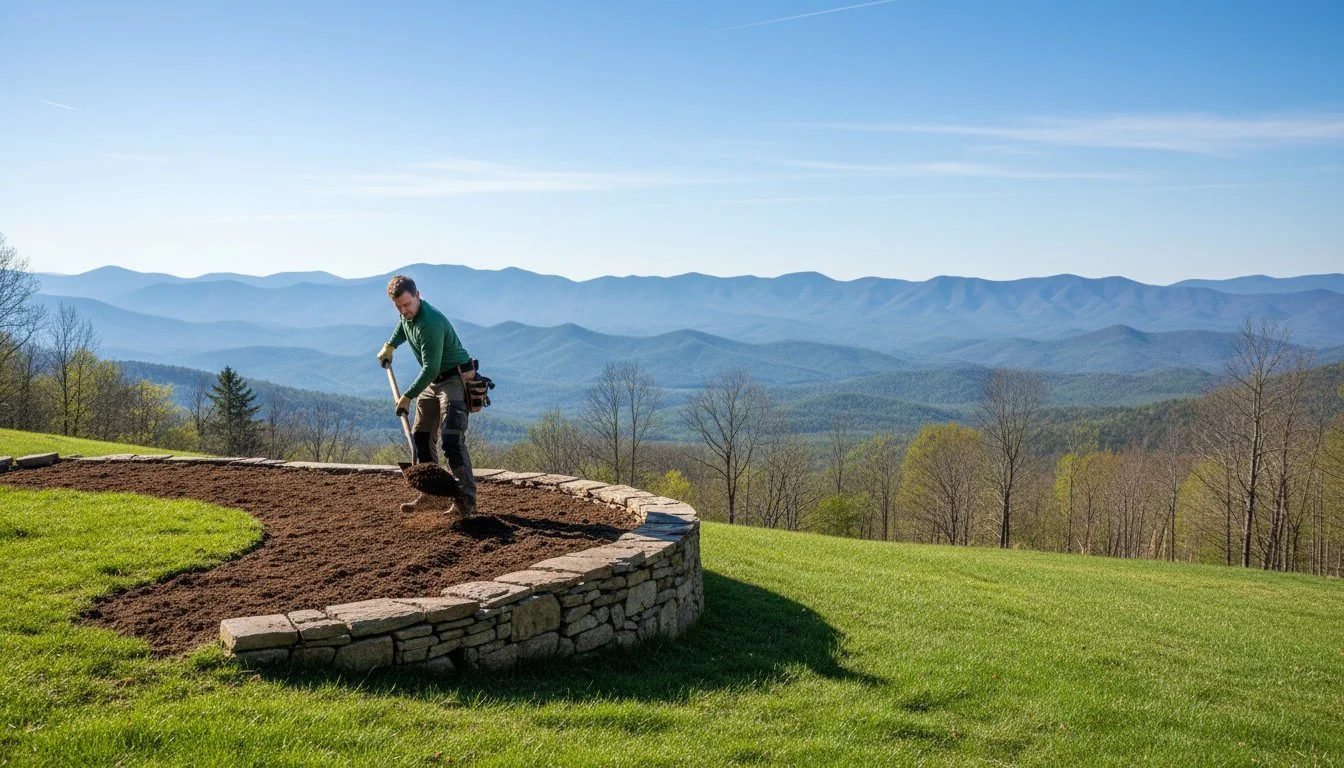
The richest, most organic compost might actually be the wrong choice for stabilizing a sloped High Country property. While it's tempting to focus solely on nutrients, the structural integrity of your landscape depends on selecting the right grade of topsoil to handle the 53 inches of annual rainfall common in Boone. You already know that gardening in the Blue Ridge Mountains means battling rocky subsoils and steep inclines that lead to rapid runoff. It's frustrating to invest in premium plants only to see your efforts wash away during a heavy mountain storm.
This guide provides the technical clarity you need to master the differences between topsoil and compost. We'll ensure you build a resilient, thriving landscape that withstands the unique mountain terrain. We will examine bulk delivery logistics, drainage solutions for sloped yards, and the specific material ratios required for productive garden beds. You'll gain the expert confirmation needed to solve your specific drainage or growth issues with a single, cost-effective delivery that prioritizes your project's long-term stability.
Key Takeaways
Understand the biological requirements of mountain terrain and why quality topsoil is the only viable solution for building a resilient landscape.
Distinguish between structural volume and nutrient density to avoid common mistakes when choosing between soil-based amendments and compost.
Implement effective drainage and grading strategies to protect sloped properties from erosion during heavy High Country storms.
Streamline your project logistics by calculating precise bulk delivery needs, saving significant time and labor compared to bagged products.
Leverage five decades of local expertise to access comprehensive landscaping solutions tailored to the unique environmental demands of the Boone area.
Defining Quality: What High Country Homeowners Need in a Topsoil
Topsoil represents the upper 5 to 10 inches of the earth’s surface, where biological activity is most concentrated. It’s the primary engine for every successful landscape project in the High Country. To understand the foundational components of this layer, you can explore What is Topsoil? to see how it differs from inert subsoil layers. Many property owners mistakenly use mountain fill dirt for planting projects. Fill dirt is designed for structural stability and leveling; it lacks the nutrient density required for plant growth. High-quality topsoil maintains a precise balance of sand, silt, and clay, enriched with organic matter. This combination ensures proper drainage while holding enough moisture to sustain roots through the 2026 growing season.
Local sourcing is a requirement for plant compatibility in Western North Carolina. Soil from the Piedmont often has a different pH and mineral profile than soil at elevations above 3,000 feet. Using local topsoil ensures that your lawn or garden integrates with the surrounding ecosystem. This consistency reduces plant stress and lowers the need for chemical amendments. All Seasons Supply focuses on providing materials that reflect the specific needs of our mountain environment, prioritizing long-term reliability for every customer.
The Anatomy of "Living" Topsoil
Healthy mountain soil is a living ecosystem. It contains billions of microorganisms and fungi that break down nutrients for plant uptake. Organic matter acts as a sponge, improving soil structure and increasing water retention by approximately 20%. Sterile, bagged soils often fail in Boone because they lack these native biological components. Without a living soil structure, plants cannot establish deep root systems in rocky High Country terrain.
Why Screened Soil Beats Unscreened Fill
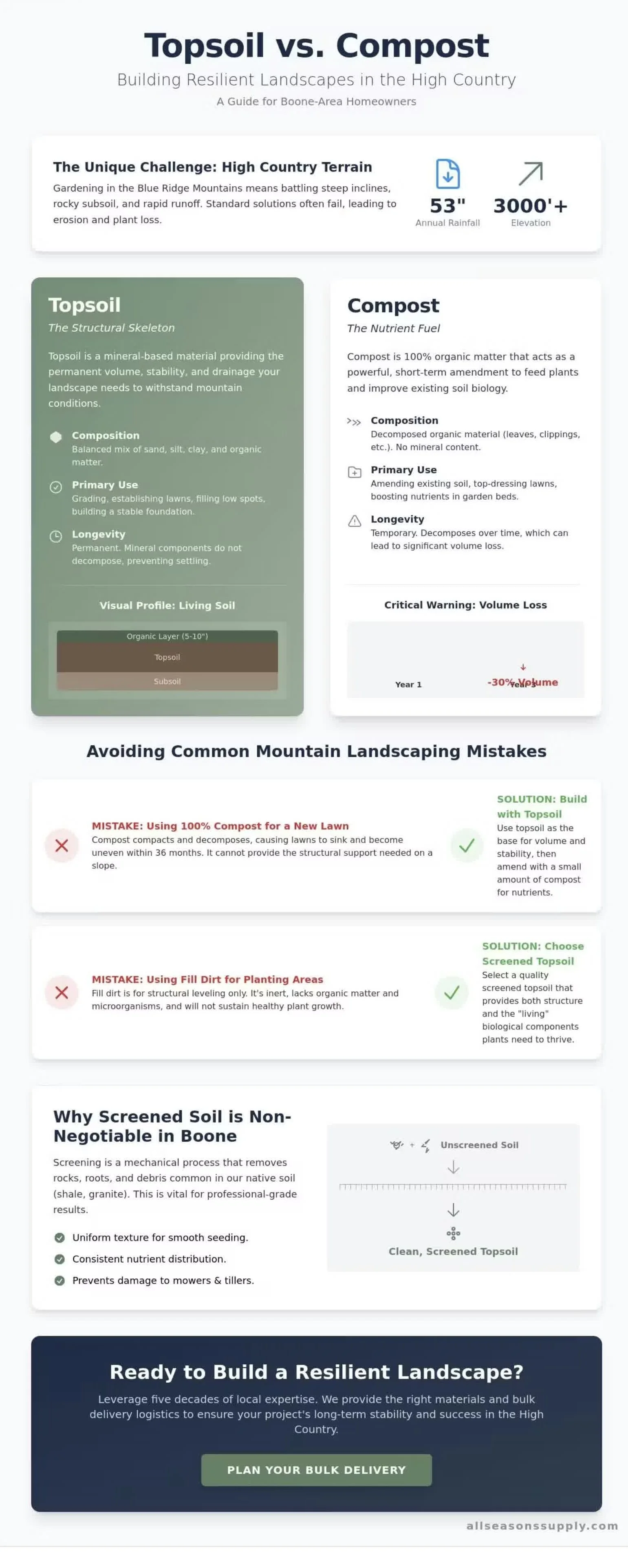
Screening is a mechanical process that removes rocks, roots, and debris. This step is vital for Boone properties where natural earth contains heavy shale and granite fragments. Screened material provides the uniform texture required for smooth lawn seeding and consistent nutrient distribution. Using unscreened fill often results in uneven germination and potential equipment damage. It is a practical solution for homeowners who prioritize efficiency and professional-grade results.
Topsoil vs. Compost: Choosing the Right Foundation for Boone Landscapes
Understanding the functional difference between topsoil and compost is the first step toward a successful landscape project in the High Country. While these materials often look similar, they serve entirely different roles in your yard's ecosystem. Topsoil provides the structural "skeleton" of your landscape. It's a mineral-based material that offers permanent volume and stability. Compost acts as the "fuel," providing a concentrated boost of organic matter and microbial life that feeds plants over a shorter duration.
A common mistake among local homeowners is attempting to grow a lawn in 100% compost. This approach often leads to structural failure. Because compost consists of organic matter, it naturally breaks down and disappears over time. A lawn bed started with pure compost can lose up to 30% of its volume within 36 months, resulting in significant settling and an uneven surface. For a permanent foundation, topsoil is the only reliable choice because its mineral components, such as sand and silt, don't decompose.
Technical specifications matter when selecting your base. According to the Topsoil Quality Guidelines, a high-quality product must maintain a specific balance of texture and pH to support root respiration. In the rugged environment of Boone, ensuring your soil has adequate drainage capacity is vital for withstanding winter's freeze-thaw cycles.
When to Use Topsoil for Leveling and Lawns
Topsoil is the preferred solution for projects requiring significant volume or structural integrity. It's the standard choice for grading around home foundations to ensure water flows away from the structure. If you're establishing a new lawn or filling deep low spots, topsoil provides the weight and density needed to stay in place. It also serves as a stable anchor for nursery plants in Blowing Rock, where heavy root balls require firm ground to prevent leaning or shifting during high-wind events. For any application exceeding 2 inches in depth, topsoil is required as a base.
When to Choose Compost for Nutrient Injection
Compost should be viewed as a biological amendment rather than a filler. It's the ideal choice for vegetable gardens, raised beds, and flower gardens where plants consume nutrients rapidly. For established Boone lawns, a process called top-dressing uses a thin layer of compost to revitalize tired soil. This application introduces beneficial microbes and acts as a slow-release natural fertilizer for 6 to 12 months. Most professional landscapers recommend a blend of 70% topsoil and 30% compost to get the benefits of both stability and fertility. Selecting high-quality landscape materials ensures your soil profile remains productive for years to come.
Beyond the Surface: Using Screened Topsoil for Grading and Drainage in the Mountains
Managing water runoff is the primary challenge for property owners in the High Country, where Boone averages 53 inches of annual precipitation. On properties with slopes exceeding 15 percent, standard dirt often fails to hold its ground during heavy mountain storms. Using high-quality topsoil provides a reliable solution by creating a permeable layer that absorbs water rather than allowing it to sheet across the surface. This absorption reduces runoff velocity, protecting your landscape and preventing the loss of expensive ornamental plantings. Reliable grading depends on soil density. When you apply screened material free of large debris, it settles uniformly, creating a stable foundation. This consistency is vital for maintaining property value, as it prevents the formation of rills and gullies that can lead to significant land loss over time. A well-planned grading project ensures operational continuity for your outdoor spaces, keeping driveways clear and lawns functional regardless of the weather.
Managing Steep Slope Erosion in Blowing Rock
Stabilizing a 20 percent grade in Blowing Rock requires more than just spreading material. You must use screened topsoil in conjunction with mechanical stabilizers, such as coconut fiber erosion blankets or silt fences, to hold the ground while root systems establish. Success depends on "knitting" the new soil into the existing mountain clay by tilling the interface layer; this prevents the new material from sliding off the hard subsoil during a flash flood. Erosion control is the strategic use of soil density and vegetation to stabilize slopes.
Improving Drainage in Clay-Heavy Mountain Soils
Watauga County is known for its heavy, compacted red clay, which resists water penetration. To correct this, professionals often incorporate topsoil and compost blends to improve soil structure. According to this NC State Extension guide to soil modification
Logistics and Calculation: Planning Your Bulk Topsoil Delivery in Watauga County
Managing a landscaping project in Watauga County requires a logistical approach that prioritizes efficiency and cost control. While purchasing individual bags of soil from a retail store might seem convenient for small flower beds, bulk delivery is the standard for professional results. A single cubic yard of material replaces approximately 27 standard 1-cubic-foot bags. For a project requiring 10 cubic yards, you avoid handling 270 plastic bags, which significantly reduces labor costs and environmental waste. Choosing professional bulk topsoil in Boone, NC, ensures your inventory arrives in a single, consistent load, allowing your team to maintain a steady workflow without the interruptions of multiple trips to a supply center.
Professional delivery provides a level of reliability that manual hauling cannot match. It's a solution that addresses the physical demands of large-scale projects while ensuring the material remains protected and contained until it's ready for application. This method is particularly effective for facility managers who need to maintain operational continuity during seasonal property upgrades.
How to Calculate Your Bulk Topsoil Needs
Precision in ordering prevents both waste and project delays. To determine the volume required, measure the length and width of the area in feet and determine your desired depth in feet. Multiply these three numbers and divide the total by 27 to find the cubic yards. For example, a 1,000-square-foot area needing 3 inches of coverage (0.25 feet) requires approximately 9.25 cubic yards of topsoil.
1 cubic yard covers 324 sq ft at 1 inch deep
1 cubic yard covers 108 sq ft at 3 inches deep
1 cubic yard covers 81 sq ft at 4 inches deep
You should always order 10% more material than your initial calculation suggests to account for natural settling and soil compaction.
Preparing Your Property for a Bulk Delivery
Delivering heavy loads in the High Country presents unique challenges, including 15% grade driveways and narrow access roads common in Watauga County. To ensure a successful drop, select a site that is flat, accessible, and clear of overhead power lines or low-hanging tree branches. Drivers typically need at least 12 feet of vertical clearance and 10 feet of width to maneuver safely. Marking the exact spot with a tarp or traffic cones provides the driver with a clear target and protects your driveway or lawn from direct contact with the material.
During the wet High Country spring season, ground saturation is a primary concern. When the soil is soft, a heavy delivery truck can cause ruts or damage to established turf. If your drop site is on a grassy area, consider placing the delivery on a reinforced surface or waiting for dry weather to ensure the equipment doesn't compromise your landscape. Planning for these environmental factors ensures your topsoil is delivered safely and efficiently.
Contact All Seasons Supply to schedule your reliable topsoil delivery and keep your project on schedule.
All Seasons Supply: Your Professional Partner for Bulk Soil and Delivery in Boone
Selecting the right topsoil involves more than just picking a product. It requires a partner who understands the logistical and biological demands of the High Country. All Seasons Supply brings over 50 years of combined experience to every project. We don't just sell dirt; we provide integrated landscape solutions. This includes everything from nutrient-dense soil to bulk mulch delivery in Boone, NC. Our goal is to ensure your project stays on schedule and your vegetation thrives in our unique climate. We act as an industrious partner, focusing on your operational continuity and the long-term success of your land.
Over 50 Years of Combined High Country Expertise
Our team understands the distinct soil profiles found across Avery and Ashe Counties. We've spent decades refining our inventory to meet the needs of high-altitude landscapes. We provide personalized consultations for both professional contractors and DIY homeowners. This ensures you receive the exact material required for your specific site conditions. Our commitment to quality means we monitor our inventory closely to ensure it's free of invasive weeds. We prioritize reliability because we know that a single bad load of topsoil can compromise an entire season of work. We offer the quiet confidence that comes from deep local knowledge and a proven track record.
Reliable Delivery Across Watauga, Avery, and Ashe Counties
Logistics in the North Carolina mountains require specialized equipment and local knowledge. Our fleet is maintained to navigate the steep grades and tight access points common in Boone, Foscoe, Blowing Rock, and Banner Elk. We offer flexible scheduling to keep your landscaping project on a predictable timeline, preventing costly delays. As a one-stop shop, we simplify your procurement process. You can source your soil, stone, and nursery stock from a single, dependable provider. This integrated approach reduces the administrative burden on facility managers and business owners.
Comprehensive Service Area: We provide consistent delivery to Watauga, Avery, and Ashe counties, including remote mountain sites.
Specialized Fleet: Our trucks are equipped to handle the unique geography and challenging terrain of the High Country.
One-Stop Shop Convenience: We maintain a robust inventory of soil, stone, and mulch to meet all your project needs.
Professional Consultation: Our experts help you solve project challenges, not just fill an order.
We value hard work and long-term relationships. Our team is always working in the background to support your success, moving at a steady, methodical rhythm that aligns with the seasonal needs of our region. When you partner with us, you aren't just buying supplies; you're gaining a reliable guide through the complexities of mountain landscaping and facility maintenance. We remain focused on providing the stability and personal accountability your professional projects demand.
Secure Your High Country Landscape Foundation
Successful landscaping in Boone requires a foundation built for the High Country's specific drainage and elevation challenges. Choosing the right topsoil ensures your grading remains stable and your plants receive the nutrients they need to thrive through 2026. Screened materials provide the consistency required for professional results; meanwhile, local delivery logistics ensure your project stays on schedule without unnecessary delays. All Seasons Supply brings 50+ years of combined local experience to every project we handle. As a locally owned and operated family business, we provide full-service delivery across Watauga, Avery, and Ashe Counties. We understand the unique terrain of Western North Carolina and offer the reliable solutions you need for a complete landscape transformation. Our team prioritizes your peace of mind by providing consistent inventory and dependable service that moves your project forward. We're ready to act as your industrious partner for all your bulk material needs.
Get a Quote for Bulk Topsoil Delivery in Boone
Let's get your next project started today.
Frequently Asked Questions
How much topsoil do I need to cover my yard in Boone?
You need one cubic yard of topsoil to cover 324 square feet at a depth of one inch. For a typical 5,000 square foot yard in Boone requiring a 3-inch base for new turf, you should order 46 cubic yards. This calculation ensures consistent coverage across uneven mountain terrain. Proper volume planning prevents project delays and minimizes the need for multiple delivery fees.
Is it better to buy topsoil in bulk or in bags for a small garden?
Bulk purchases are the most efficient solution for any project exceeding 25 square feet. A single cubic yard contains 27 cubic feet, which would require 36 standard bags from a retail store. Choosing bulk delivery reduces plastic waste and ensures a consistent soil composition across your entire garden bed. It streamlines the labor required for larger landscaping installations in Watauga County.
What is the difference between topsoil and garden soil?
Topsoil is the screened, mineral-heavy upper layer of earth used for filling low spots or establishing lawn bases. Garden soil is a specific blend that incorporates 20% to 30% organic matter, like compost or peat moss, to support plant growth. Use topsoil for structural grading and garden soil for nutrient-dense planting beds. This distinction ensures your landscape has the correct drainage and fertility levels.
Can I use topsoil for my indoor potted plants?
Don't use topsoil for indoor potted plants, as it lacks the porosity needed for container drainage. Standard earth is too heavy and compacts quickly, which suffocates root systems within 90 days. Indoor plants require a sterile potting mix containing perlite or vermiculite. These professional-grade mixes maintain 50% air space to ensure long-term plant health and moisture regulation.
How much does bulk topsoil delivery cost in Watauga County?
Delivery fees in Watauga County depend on the distance from the distribution center and the total cubic yardage ordered. Most local suppliers calculate rates based on a 10- or 20-mile radius from their facility. Ordering a full 10-yard truckload is typically more efficient than scheduling multiple smaller deliveries. Contact a local specialist to receive a precise quote based on your specific site coordinates and project volume.
Will topsoil help with drainage issues on my mountain property?
Topsoil helps manage surface runoff when applied to create a 2% slope away from your home's foundation. It fills depressions where water pools, but it won't resolve deep drainage problems caused by the heavy clay subsoil found in Boone. For severe issues, integrate a French drain system with your topsoil application. This dual approach ensures water moves efficiently across your mountain property during heavy rainfall.
What happens if I put too much topsoil on my existing lawn?
Adding more than 0.5 inches of soil over existing grass will likely suffocate the turf and cause root rot. If you're top-dressing to level a lawn, keep the application thin enough so the grass blades remain visible. For areas requiring 2 inches or more of elevation change, you'll need to replant the entire section. This methodical approach preserves your current lawn while improving the overall soil structure.