Topsoil vs. Compost: Which Does Your Boone, NC Garden Actually Need?
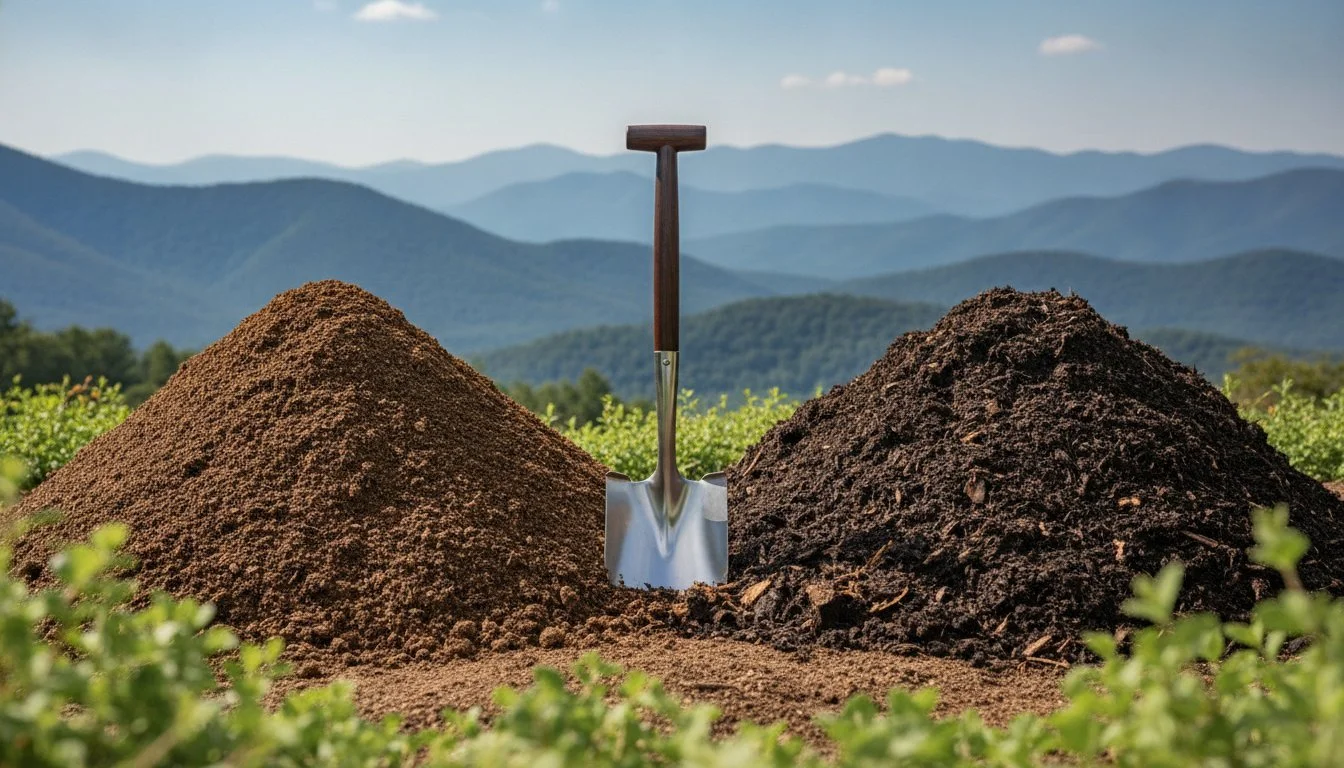
Adding more fertilizer won't fix a garden bed that's essentially sitting on a shelf of Blue Ridge rock. Most homeowners and property managers in the High Country face the same uphill battle against heavy clay and a short growing season, which leaves little room for error. When you're planning a project, deciding between topsoil and compost in Boone, NC, is the most important logistical decision you'll make to ensure your landscape survives the mountain climate.
We know that your time and resources are valuable; guessing which bulk material to order often leads to unnecessary costs and stalled progress. This article provides a clear, professional breakdown of how these materials function differently as strategic tools for your land. You'll discover which one builds the physical foundation your terrain needs and which one provides the essential nutrients for plant health. We also reference local factors, such as the Town of Boone’s soil erosion standards, updated in May 2026, to help you manage your project with total confidence and efficiency.
Key Takeaways
Learn the distinct roles of topsoil for structural volume and compost for biological enrichment to avoid wasting resources on the wrong material.
Identify when to prioritize bulk topsoil for foundational tasks, such as leveling uneven terrain or preparing a stable base for new High Country sod.
Discover how compost serves as a strategic tool for amending heavy clay and improving aeration in the challenging topsoil vs compost Boone NC decision process.
Evaluate your project requirements to choose the most cost-effective solution, whether you're filling deep holes or revitalizing existing vegetable garden beds.
Benefit from 50 years of industry experience by sourcing materials that match the unique pH and climate demands of the Blue Ridge Mountains.
Understanding Topsoil vs. Compost in the High Country
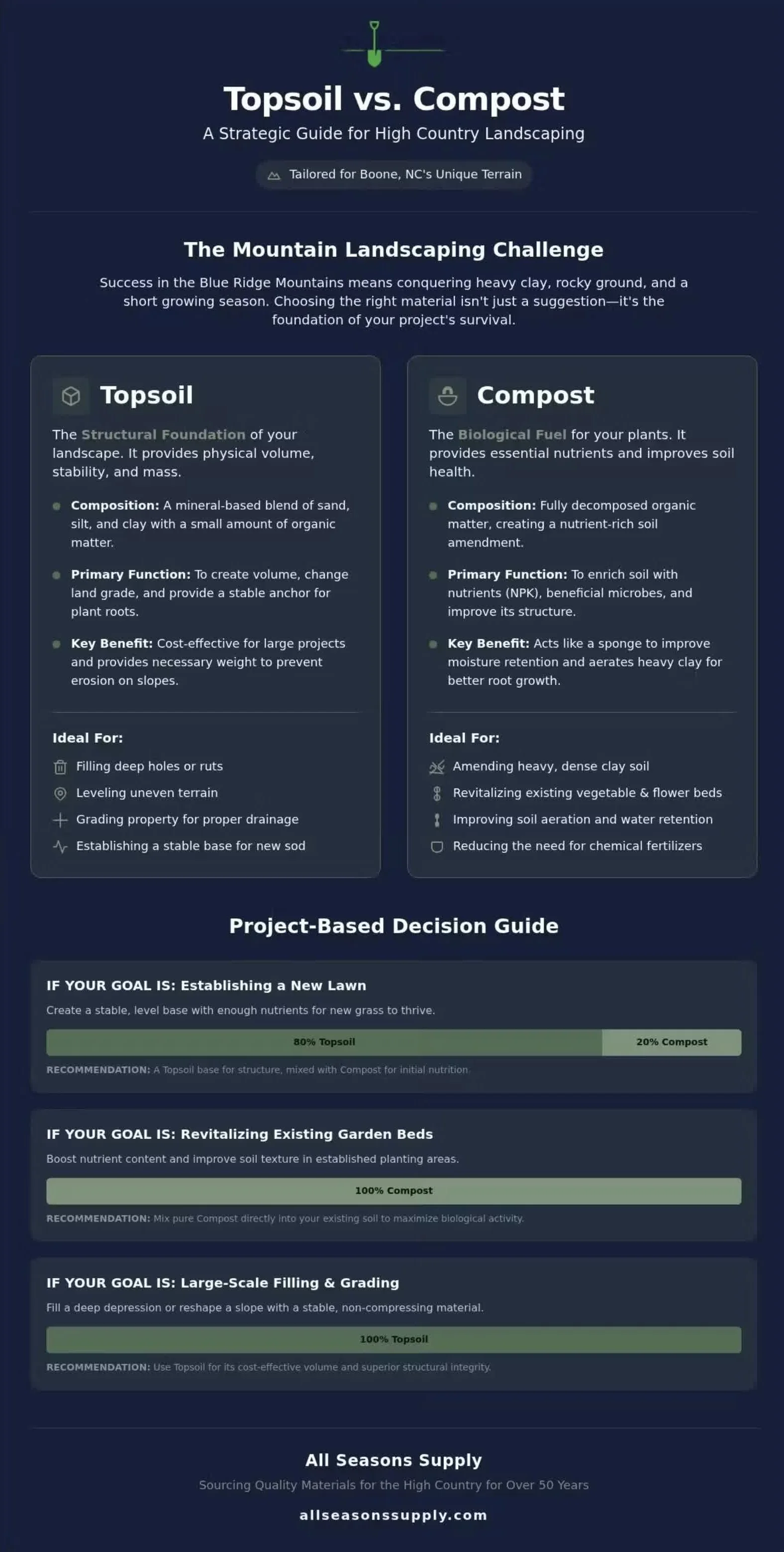
In the High Country, successful landscaping requires more than just picking the right plants; it demands a strategic approach to the ground they grow in. Properties in Boone, Blowing Rock, and Banner Elk often sit on a combination of dense clay and ancient rock. To manage these conditions effectively, you must understand the functional roles of topsoil and compost. They are not interchangeable. Think of topsoil as the physical foundation of your garden and compost as the biological fuel that drives growth. Choosing the right balance of topsoil vs. compost for your Boone, NC project ensures that your investment in nursery trees or perennials doesn't go to waste.
The distinction is particularly important because of our unique mountain climate. Local professionals deal with heavy runoff during spring thaws and rapid drainage on steep slopes. If you use compost where you need structural topsoil, your garden bed may wash away or sink as the organic matter breaks down. Conversely, using only topsoil without an amendment can leave your plants struggling to find nutrients in compacted clay. A professional, dependable approach involves using these materials as complementary tools to ensure operational continuity for your landscape.
What is Topsoil Exactly?
Topsoil is technically the uppermost layer of the earth, usually the top 2 to 12 inches. It consists of a specific blend of sand, silt, and clay, along with a small percentage of organic matter. For residential or commercial projects in the Blue Ridge Mountains, we recommend screened topsoil. Screening removes large rocks and debris common in our local terrain, providing a uniform texture that is easy to spread. This material provides sufficient volume to level mountain slopes or fill deep depressions. It acts as a stable medium in which root systems can anchor securely against high-elevation winds. Without this structural base, your landscape lacks the physical integrity required for long-term stability.
The Power of Organic Compost
While topsoil provides the structure, compost provides the life. What is compost? It's the result of decomposed organic materials, such as yard trimmings or food waste, which have been broken down into a nutrient-rich soil amendment. Compost introduces beneficial microbes and essential nutrients, such as nitrogen, phosphorus, and potassium (NPK), back into the soil. In the High Country, where soil can often be excessively rocky or sandy in certain pockets, compost is essential for improving moisture retention. It acts like a sponge, holding water near the roots during dry spells. Professional gardeners often call it "black gold" because it transforms the typical red clay of Watauga County into a productive, aerated growing environment. Using it correctly can drastically reduce the need for chemical fertilizers, making it a cost-effective tool for long-term land management.
When Topsoil is the Right Choice for Your Boone Property
Topsoil acts as the heavy lifter for High Country landscaping. When your goal is to change the physical shape of your land or provide a massive amount of fill, topsoil is the superior tool. While the topsoil vs. compost debate in Boone, NC, often focuses on plant health, professional property managers know that structural integrity comes first. Topsoil provides the necessary weight and density to stay in place on sloped mountain lots where lighter materials would wash away during a heavy Blue Ridge downpour.
Because it's composed primarily of sand, silt, and clay, topsoil offers the volume needed for large-scale grading projects at a much lower cost than nutrient-dense amendments. It's the economical choice for redirecting water runoff or filling deep depressions. Selecting a product that meets quality topsoil guidelines ensures your base layer is free of excessive debris and has the right texture for long-term stability. Understanding the balance between topsoil and compost in Boone, NC, is essential for cost-effective procurement and operational success on larger properties.
Leveling and Grading Mountain Terrain
High Country winters are notoriously hard on the land. Rapid freeze-thaw cycles and heavy snowmelt often leave behind ruts and hollows in your lawn. Using topsoil to fix these uneven sections is a matter of operational efficiency. Its mineral-heavy composition ensures it won't compress as quickly as organic matter. This makes it ideal for filling low spots near foundations, where proper drainage is critical to protecting your structures. It provides a firm, reliable surface that resists erosion better than lighter, fluffier materials.
Establishing a New Lawn Foundation
Before you lay a single piece of sod or spread grass seed in Watauga County, you must establish a proper base. Most successful lawn installations in our region require at least four to six inches of quality soil to allow root systems to penetrate deep enough to survive our harsh winters. Mixing a fresh layer of topsoil with your existing native soil creates a crucial transition zone; this prevents the pancake effect, where new roots refuse to grow into the harder ground below. This foundational step is a core part of any strategy in Top Soil Near Me: A Guide to High Country Garden Success in Boone, NC. If you're managing a large property with significant acreage, choosing bulk delivery ensures you have the volume necessary to complete the job without interruption. For those ready to start their next project, All Seasons Supply offers the reliable delivery services needed to keep your operations moving.
Why Compost is the Secret to Successful Mountain Gardening
While topsoil provides the structure for grading, compost provides the biological activity that transforms inert mountain dirt into a productive garden. High Country property owners often struggle with soil that is either too acidic or too compacted to support healthy growth. When weighing the benefits of topsoil vs. compost in Boone, NC, think of compost as a high-performance additive rather than a foundational filler. It's the most efficient way to overcome the limitations of our local terrain and ensure your landscaping investment pays off.
Beyond simple nutrient delivery, compost introduces a complex web of microbial life into your beds. These beneficial organisms help suppress soil-borne diseases and pests, which reduces your reliance on chemical interventions. This proactive approach to land management ensures that your perennials and vegetable crops remain resilient throughout our short, intense growing season. It's a strategic investment in the long-term health of your property that yields visible results in plant vigor and bloom quality. Using compost correctly is a hallmark of a well-managed High Country estate.
Fixing 'Boone Clay' and Rocky Dirt
North Carolina clay is notorious for its tight chemical bonds that prevent water and air from reaching plant roots. Compost breaks these bonds by introducing organic matter that creates "tilth," the crumbly, dark texture that signifies healthy soil. By increasing the Cation Exchange Capacity (CEC), compost allows your soil to hold onto nutrients more effectively. This means that when you apply fertilizer, it stays in the root zone rather than washing down a mountain slope. It turns the "Boone Clay" from a liability into a functional growing medium.
Feeding Your High Country Plants
Successful mountain gardening requires a steady supply of nutrients, especially for heavy feeders like tomatoes or native rhododendrons. Compost acts as a natural, slow-release fertilizer that feeds your plants over several months. For established landscapes, we recommend using compost as a top-dressing. Spreading a one-inch layer around the base of your shrubs provides a steady stream of nutrients while acting as a protective mulch. For more detailed advice on selecting the right species for our elevation, see The Complete Guide to Nursery Plants in Blowing Rock. This methodical approach to feeding ensures your landscape remains vibrant year after year without the peaks and valleys associated with synthetic fertilizers.
The Comparison Matrix: Choosing the Right Material for Your Project
Selecting the correct material is a matter of matching the soil's physical properties to your property's logistical requirements. In the High Country, your choice impacts everything from erosion control to plant survival rates. While cost often dictates procurement, the topsoil vs. compost decision in Boone, NC, should be driven by the specific operational goal of your project. Using the wrong material for the task leads to wasted resources and potential property damage during our heavy mountain rain cycles.
Topsoil vs. Compost Comparison Table
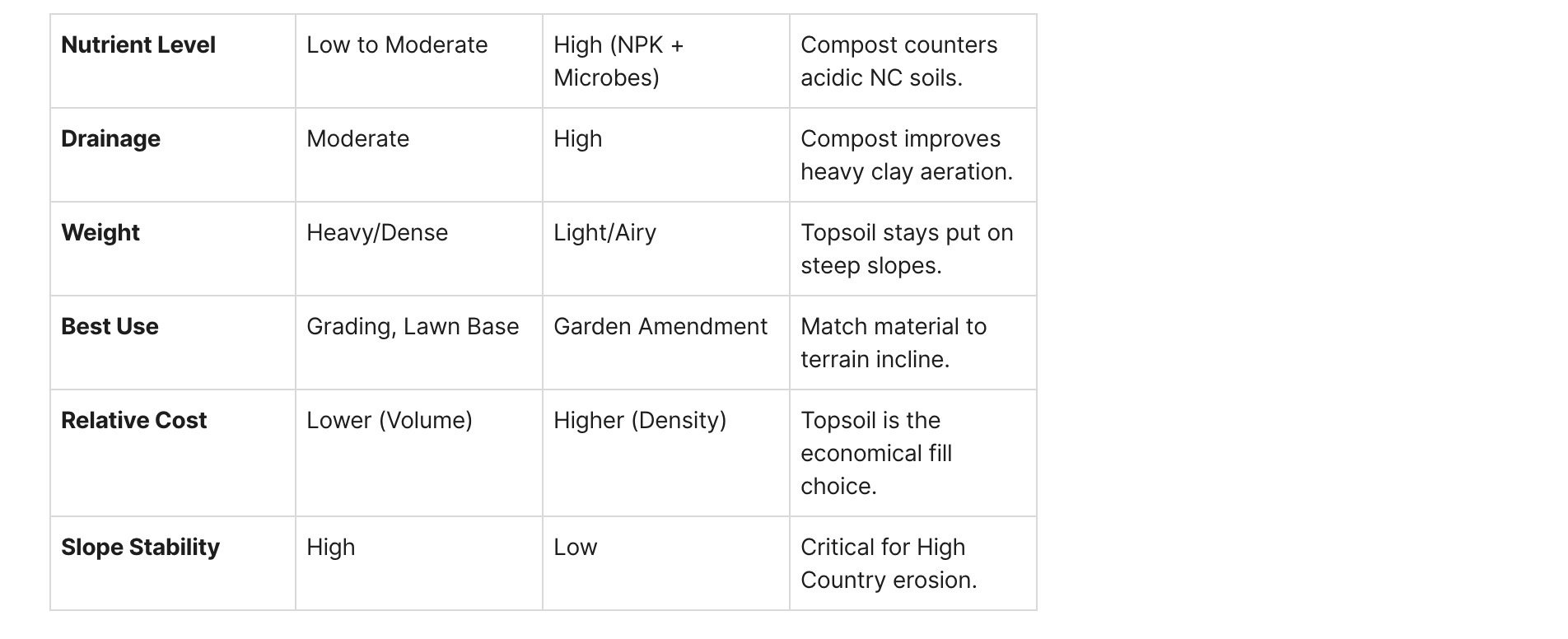
This matrix provides a professional overview of how these materials perform across key categories. Use this data to determine which tool fits your current site needs.
The High Country 50/50 Mix
Many professional Boone landscapers prefer a pre-mixed soil-and-compost blend for general gardening. This strategic operational tool provides the structural benefits of topsoil with the biological boost of compost in a single delivery. A 50/50 mix is the ideal application for raised garden containers and new flower beds. It ensures that your plants have a stable medium for anchoring their roots while receiving a steady supply of nutrients. This blend eliminates the need for on-site manual mixing, improving project efficiency and ensuring a consistent growing environment across your entire property.
Accurately calculating your needs is the final step in a successful procurement process. Measure the length and width of your project area along with the desired depth in inches. Most bulk materials are sold by the cubic yard; ordering the correct volume prevents wasted material and keeps your job site organized. If you're managing multiple projects or a large mountain estate, schedule your bulk material delivery with a partner who understands the logistical challenges of Watauga, Avery, and Ashe counties. We provide the dependable service you need to keep your landscaping operations running smoothly, regardless of the season.
Sourcing Bulk Soil and Compost in Boone, NC
Sourcing bulk materials in the High Country requires a partner who understands the practical realities of mountain terrain. When you evaluate topsoil vs compost Boone NC, the origin of your material is just as important as its composition. Locally sourced products are essential for maintaining the ecological integrity of your property. Materials brought in from outside the region can introduce invasive species or non-native weed seeds that thrive in our specific climate. Local materials are naturally aligned with the acidic pH levels common in Watauga, Avery, and Ashe counties. This ensures a more seamless transition for your nursery trees and perennials.
Choosing a local supplier also means your delivery is handled by someone who knows the roads. Navigating a heavy delivery truck up a steep drive in Beech Mountain or through the narrow turns of Foscoe requires professional coordination. Our drivers are accustomed to the logistical challenges of the Blue Ridge Mountains, but site preparation remains key to a successful drop-off. Proper planning ensures that your material arrives exactly where you need it, preventing double-handling and keeping your project on schedule.
The All Seasons Supply Advantage
We leverage 50 years of combined industry experience to ensure you receive the right material for your specific zip code. A property in Banner Elk may have different drainage requirements than one in the valley, and we provide the expertise to help you choose between screened topsoil or nutrient-dense compost. We are a locally owned family business committed to providing the steady, reliable service that High Country property owners depend on. For detailed advice on preparing your ground for a large drop-off, see our guide on Bulk Mulch Delivery in Boone, NC. This resource offers practical tips for site preparation that also apply to soil and compost deliveries.
Planning Your Delivery
Efficiency starts with a clear drop-off plan. We recommend marking your desired delivery spot with a tarp or cones to provide our drivers with a clear target. This is especially important for large-scale projects that require multiple loads. Understanding volume is also critical for your budget. A standard delivery truck typically carries between 5 and 7 cubic yards of soil or compost, depending on the material's moisture content and weight. The choice between topsoil and compost in Boone, NC, becomes much simpler when you have a partner who manages the logistics for you. Contact All Seasons Supply today for a personalized consultation and a quote tailored to your specific landscaping needs. We're here to ensure your mountain property thrives through every season.
Optimize Your High Country Landscape with the Right Foundation
Successful land management in the Blue Ridge Mountains requires a clear understanding of your site's physical and biological needs. Screened topsoil provides the necessary structural volume for grading and lawn repair, while organic compost acts as the essential fuel for plant vitality in our heavy clay soils. When evaluating topsoil vs. compost in Boone, NC, your choice should always align with the long-term operational goals of your property. Selecting the right material prevents waste and ensures your landscape remains resilient to our unique climate challenges.
All Seasons Supply serves as a dependable partner for High Country property owners. We're a family-owned and locally operated business with 50+ years of combined experience serving Watauga, Avery, and Ashe counties. Our team understands the logistical complexities of mountain deliveries and the specific soil chemistry of our region. We prioritize your project's continuity by providing high-quality bulk materials delivered directly to your site.
Order Your Bulk Topsoil or Compost from All Seasons Supply Today! We look forward to supporting your next project and helping your mountain garden reach its full potential.
Frequently Asked Questions
Can I use 100% compost in my garden beds?
You shouldn't plant directly into 100% compost. While it's nutrient-dense, it lacks the mineral structure provided by topsoil. Pure compost also drains too quickly and can settle significantly as it continues to decompose. For the best results in High Country raised beds, we recommend a blend of 50% topsoil and 50% compost to provide both the stability and the biological fuel your plants require.
Is it better to put compost on top or mix it in?
The application method depends on your project's current stage. If you're establishing a new garden bed, mixing compost into the top six inches of soil is the most effective way to improve aeration and drainage in heavy clay. For established landscapes, top-dressing with a one-inch layer is a better strategy. This allows nutrients to slowly filter down to the roots while also acting as a protective mulch for your perennials.
How much topsoil do I need for a new lawn in Boone?
Most new lawns in the High Country require a base layer of four to six inches of quality topsoil. This depth ensures that grass roots have enough room to establish themselves before hitting the rocky subsoil or heavy clay typical of our region. When calculating your order of topsoil vs. compost in Boone, NC, remember that one cubic yard covers approximately 81 square feet at a depth of four inches.
Does topsoil contain weed seeds?
Any natural, screened topsoil will contain some dormant weed seeds. While the screening process removes large rocks and roots, it doesn't sterilize the soil. Once you spread the material and provide water and sunlight, these seeds may germinate. We recommend applying a layer of mulch or establishing your desired groundcover quickly to suppress weed growth and protect your new soil from High Country wind erosion.
What is the difference between potting soil and topsoil?
Potting soil is a specialized medium designed for containers, often containing peat moss and perlite for maximum drainage. Topsoil is actual earth meant for outdoor grading, lawn repair, and foundational volume. You shouldn't use topsoil in small pots because it's too heavy and will compact, suffocating the roots. Conversely, potting soil is far too expensive and light for large-scale outdoor landscaping or grading projects.
Will a delivery truck damage my driveway in the High Country?
A fully loaded delivery truck is extremely heavy and can potentially crack asphalt or thin concrete driveways, especially on steep mountain inclines. We prioritize operational safety and recommend designating a drop-off point on a stable, gravel surface or at the edge of your property whenever possible. If you're unsure about your driveway's capacity, our experienced drivers can help you evaluate the best logistical approach during delivery to protect your infrastructure.
How often should I add compost to my gardens?
Adding a fresh layer of compost once a year is an excellent way to maintain soil health and nutrient levels. Most local gardeners apply this amendment in early spring, before the growing season begins, or in late fall to protect the soil over winter. This consistent schedule ensures that microbial activity in your garden remains high, which helps your plants resist disease and withstand the stresses of our short mountain growing season.
What is the best time of year to buy bulk soil in North Carolina?
The ideal time to purchase bulk soil is in spring or early fall, when the ground is workable. The choice of topsoil vs. compost in Boone, NC, is most critical during these windows to ensure successful seed or sod establishment. Purchasing your materials before the heavy spring rains or the first hard freeze of winter ensures that you can grade and level your property with maximum efficiency and minimal site disturbance.