
Best Mulch for Steep Slopes in Blowing Rock: 2026 Erosion Control Guide
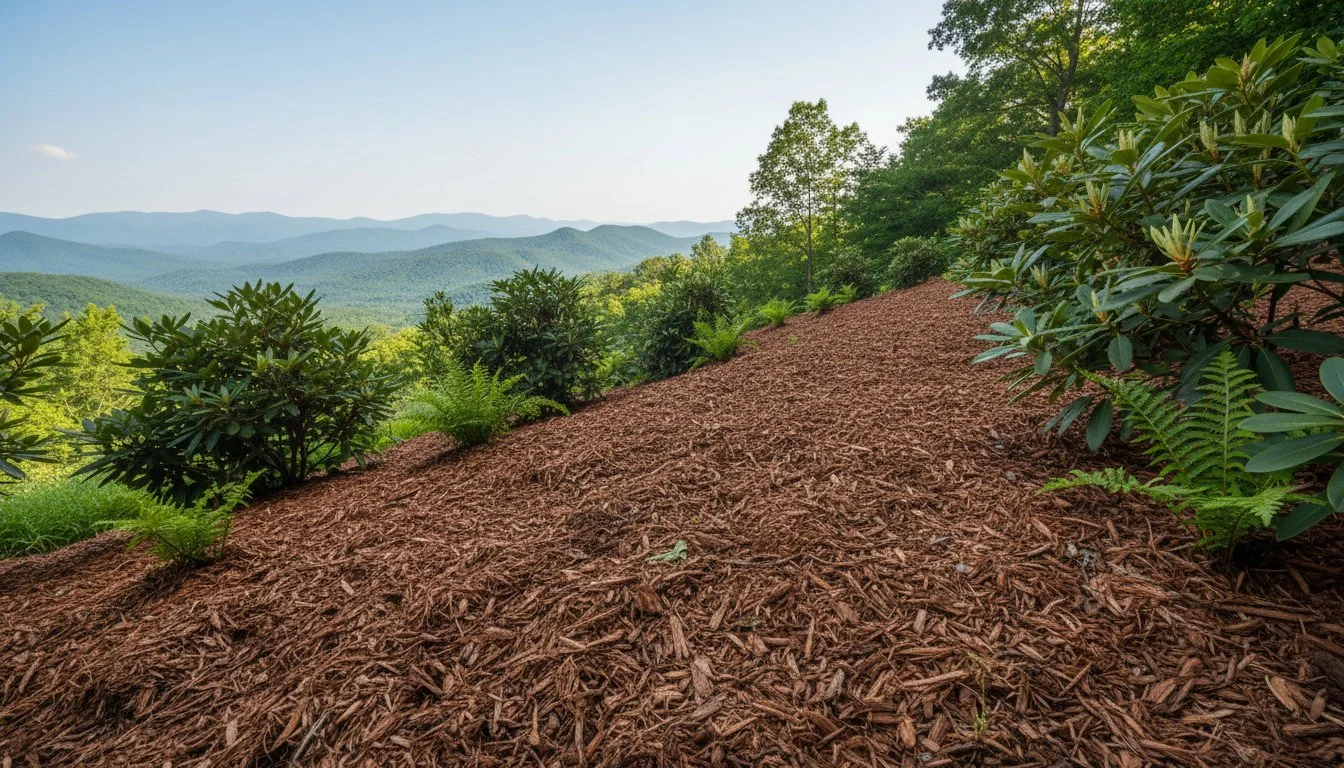
If you are waiting for a heavy mulch to simply weigh down your hillside against a Blowing Rock downpour, you are fighting a losing battle against gravity. Most homeowners assume density is the key to stability. However, they still find their landscape beds at the bottom of the driveway after every heavy rain. Finding the best mulch for steep slopes in Blowing Rock requires shifting from weight to mechanical interlocking.
It's exhausting to watch your investment wash away while your yard erodes. Under the North Carolina Sedimentation Pollution Control Act, you have a 21-day window to stabilize exposed slopes, so your choice of ground cover is a critical operational decision. This guide explains which mulch varieties, such as shredded hardwood, naturally knit together to stay put. We will show you how to achieve a stable, attractive hillside that protects your plant roots and minimizes the need for constant re-application. By selecting materials that serve as strategic tools for your landscape, you can ensure your property remains compliant and well-maintained throughout the High Country's unpredictable weather cycles.
Key Takeaways
Identify why shredded hardwood is the best mulch for steep slopes in Blowing Rock due to its unique ability to interlock and resist mountain runoff.
Understand the "knitting" effect and how specific wood fibers physically entangle to create a stable, erosion-resistant mat on 20-degree grades.
Master strategic installation techniques, including "toe" trenching, that provide a physical anchor for ground cover against gravity and wind.
Calculate your material needs accurately by accounting for the 15-20% volume increase required for steep mountain terrain compared to flat surfaces.
Determine why bulk delivery of Hardwood or Designer mulches is the most efficient operational choice for scaling erosion control on large acreages.
Understanding Blowing Rock’s Terrain: Why Standard Mulch Fails on Slopes
Blowing Rock is defined by its dramatic elevation changes. While these vistas are a primary draw for property owners, they present a significant operational challenge for landscape maintenance. Standard landscaping materials often fail because they lack the structural integrity to withstand the local topography. Identifying the best mulch for steep slopes in Blowing Rock requires an understanding of how 20-degree mountain grades accelerate water runoff. When rain hits a vertical drop, it gains velocity quickly. This turns a gentle drizzle into a forceful stream that carries unanchored materials directly into your drainage system.
The financial implications of using the wrong material are immediate and recurring. Every time a storm clears, property owners often find their mulch beds deposited in drainage ditches or across driveways. This constant cycle of re-application is a drain on resources and leaves soil exposed to the elements. To understand what mulch is intended to do, one must look beyond simple aesthetics. It serves as a strategic tool for soil stabilization. Many standard products are simply too light or too smooth to provide the necessary friction against the thin, rocky High Country soil that characterizes our region.
The Role of Gravity and Grade
Slope percentage dictates the specific friction required for a ground cover to remain stationary. For most loose-fill materials, such as pine nuggets or large bark chips, the point of failure occurs much sooner than property owners expect. These materials are prone to "floating," a process in which water seeps beneath the mulch, lifting it from the soil surface. Once the material becomes buoyant, gravity pulls it down the hillside with very little resistance. In Watauga County, this floating effect is the leading cause of mulch loss on developed lots. You need a material that doesn't just sit on the soil but grips it.
High Country Weather Patterns
Blowing Rock faces unique environmental stressors, including high-velocity winds that sweep across the ridges before a storm front arrives. Light mulches are often blown away by wind before the rain even begins, leaving the soil vulnerable. When high-volume rain events follow, the lack of a cohesive barrier leads to rapid erosion and exposed root systems. The High Country Washout is a specific phenomenon in which the combination of steep grade and soil saturation creates a slide effect that standard mulches cannot withstand. Success depends on choosing a product that weighs itself down through texture and interlocking fibers rather than just sheer mass.
Top Mulch Recommendations for Erosion and Slope Stability
Selecting the best mulch for steep slopes in Blowing Rock involves evaluating the physical geometry of the wood fibers. While many retail options focus solely on color, high-performance erosion control relies on the material's ability to form a unified barrier. Professional-grade Shredded Hardwood is widely considered the industry standard for this application because of its unique structural properties. It provides the necessary friction to resist the gravitational pull that typically displaces lighter materials.
Shredded Hardwood: The Structural Choice
The double-shredding process is critical for hillside stability. This mechanical processing produces long, jagged fibers that act like Velcro, physically hooking together to form a cohesive mat. This interlocking mechanism is the primary defense against the "floating" issue that plagues mountain landscapes. Hardwood also has a significant weight advantage over softwoods like pine or cedar, providing greater downward pressure on the soil surface. For those looking for a comprehensive look at material properties, The Ultimate Guide to Mulch Near Me offers deeper insights into how hardwood supports long-term landscape health.
Designer Mulches for Visual Impact
Designer mulches are not just for aesthetic appeal. All Seasons Supply provides Designer Brown and Designer Black Mulch specifically engineered with heavy wood fibers that maintain stability on inclines. These products use carbon-based dyes that bond to the wood, ensuring the color remains vibrant even under the intense UV exposure at High Country elevations. A functional benefit of these dyes is the ability to monitor erosion. If a specific area begins to thin or shows soil through the dark color, it serves as an early warning sign of drainage issues. Following local mulch recommendations for construction-grade stabilization ensures your property remains compliant with state erosion standards.
For areas with acid-loving flora, such as native rhododendrons or azaleas, Shredded Pine Bark is a specialized alternative. It offers similar interlocking benefits to hardwood while maintaining the soil acidity these mountain plants require to thrive. However, property owners should strictly avoid pine nuggets and cypress chips. These materials are known as "slope-killers" because their rounded, smooth surfaces offer no friction. They act like marbles on a grade, rolling downhill during wind events or floating away during moderate rain. Choosing a high-fiber material like Hardwood Mulch ensures your investment stays where you put it, protecting your plant roots and your budget.

The Science of "Knitting": Why Shredded Hardwood Stays Put
Stability on a mountain hillside isn't a result of sheer mass. It's a result of geometry. While many property owners look for the heaviest material available, the best mulch for steep slopes, Blowing Rock relies on a physical process known as knitting. This term describes how individual wood fibers physically entangle to form a continuous, flexible mat. Unlike uniform chips or nuggets, which act as independent units, shredded hardwood functions as a single structural barrier. This collective strength is what prevents gravity from pulling your landscape bed down the ridge during a seasonal storm.
Fiber Entanglement Explained
The double-shredding process creates jagged, irregular edges on every piece of wood. These microscopic hooks and uneven surfaces are absent in smoother, decorative barks. When you spread this material, the fibers overlap and catch onto each other, creating a velcro-like effect. These irregularities also increase the surface area in contact with the ground, generating significant friction against the soil. When properly settled, shredded hardwood provides the structural integrity necessary to resist displacement on slopes reaching up to 35 degrees. This mechanical bond is far superior to the loose-fill nature of pine nuggets, which often fail on even modest inclines during the first heavy rain.
Initial weather exposure actually improves this bond. While heavy rain can wash away most materials, a moderate initial saturation helps settle the shredded fibers into the soil's top layer. As the wood begins its slow process of organic decomposition, it develops a natural adhesion. Fungal mycelium and fine organic particles act as a biological glue, further cementing the mulch mat in place. This transition from a loose application to a stable ground cover is essential for long-term erosion control in the High Country.
Infiltration vs. Runoff
A knitted mulch layer serves a critical hydraulic function by slowing down water velocity. When rainwater hits a bare slope or a bed of smooth chips, it sheets off, gaining speed and carrying soil with it. A dense mat of shredded hardwood breaks the fall of raindrops, forcing the water to navigate a complex path through the fibers. This delay allows the water to seep into the soil gradually rather than rushing over the surface. For the native rhododendrons and mountain laurels common in Blowing Rock, this infiltration is vital. It ensures that moisture reaches the root zone while preventing the high-velocity runoff that strips away valuable topsoil and nutrients. By choosing a material that mechanically manages water flow, you protect both your plants and the structural integrity of your hillside.
Strategic Installation: How to Anchor Mulch on High Country Hillsides
Selecting the best mulch for steep slopes in Blowing Rock is only the first step in a successful erosion control strategy. The effectiveness of any material depends heavily on its installation. In the High Country, gravity and high-velocity runoff are constant factors. To ensure your ground cover remains stationary, you must move beyond simple spreading and adopt mechanical anchoring techniques. Proper preparation ensures that the mulch establishes immediate contact with the soil, creating the friction necessary to resist displacement during the first storm event.
The "No-Slide" preparation begins with clearing all existing debris from the slope. If you spread new mulch over a layer of dry leaves or old, loose material, you are effectively creating a lubricant layer. The new mulch will slide off the old debris as soon as it becomes saturated. For maximum stability, your material must have direct contact with the mineral soil or a stable base.
This foundation allows the interlocking fibers of shredded hardwood to grip the terrain rather than sitting loosely on top.
The Mountain Trenching Technique
Digging a 3-4 inch "V" trench at the lower perimeter of your mulch bed is a non-negotiable step for mountain grades. This trench, often called the "toe" of the slope, serves as a physical catch basin for both water and material. When runoff flows down the hillside, the trench intercepts the water's velocity and provides a space for any shifting mulch to settle. This prevents the "waterfall effect" that typically carries ground cover into driveways or drains. Maintenance is straightforward. Periodically check these trenches after heavy rains and clear out any accumulated silt to keep the drainage path functional.
Avoiding the Fabric Trap
Many property owners mistakenly install plastic landscape fabric on hillsides to prevent weeds. On a steep grade, this is a critical error. Plastic fabric creates a smooth, non-porous surface that acts as a slip-and-slide for organic material. Even the best interlocking mulch cannot grip a plastic sheet. Instead, we recommend using cardboard or biodegradable paper as a base. These materials provide the necessary friction to hold your ground cover in place while slowly decomposing into the soil. Coordination is key to a successful project. You can schedule your Bulk Mulch Delivery in Boone, NC, to arrive at exactly the time your site preparation is complete.
The final step in any hillside installation is the "Wet-Set" method. Immediately after spreading your mulch, you should saturate the entire area with water. This initial soaking helps the shredded fibers settle into the soil and begin the "knitting" process described earlier. For extreme slopes exceeding 35 degrees, supplemental aids like jute netting or coconut coir logs can provide additional temporary support while your perennials and shrubs establish their root systems. These tools work in tandem with your mulch to create a comprehensive, long-term erosion control solution.
Bulk Mulch Delivery: Scaling Your Erosion Control in Blowing Rock
Managing a large mountain acreage requires a shift from residential gardening tactics to operational landscape management. For properties in the High Country, bagged products are rarely a viable solution. Bulk delivery provides the volume necessary to establish a consistent, deep layer of protection across expansive hillsides. When you are sourcing the best mulch for steep slopes in Blowing Rock, the efficiency of your procurement process is just as important as the material itself. A single bulk delivery ensures you have the inventory on hand to complete your stabilization project within the state-mandated 21-day window.
Calculating the correct volume for a slope is a technical requirement that many property owners overlook. A standard flat-ground measurement fails to account for the increased surface area created by a grade. To achieve a depth of three to four inches on a steep hillside, you typically need 15% to 20% more material than a horizontal footprint suggests. Underestimating this volume leads to thin spots where the knitting process cannot fully engage, leaving the soil vulnerable to the very erosion you are trying to prevent. Ordering a surplus ensures you can reinforce high-velocity runoff zones and maintain the structural integrity of the entire bed.
The Logistics of Mountain Delivery
High Country terrain presents unique navigational challenges that standard delivery services are often unprepared to handle. With over 50 years of experience, our team has developed the specialized knowledge required to navigate steep, winding driveways throughout Boone, Blowing Rock, and Watauga County. We prioritize strategic placement to minimize the labor-intensive task of uphill wheelbarrowing. By identifying custom delivery spots closer to your target beds, we help ensure your project moves forward with maximum efficiency. Timing is equally critical. We recommend scheduling your delivery to coincide with the early Blowing Rock planting season, allowing your ground cover to settle before the heavy summer storm cycles begin.
The All Seasons Supply Advantage
We provide locally sourced materials specifically selected to perform in the High Country ecosystem. Our Hardwood and Designer mulches are more than decorative finishes; they are strategic operational tools designed for stability and durability. Because we understand the local climate and soil composition, we can offer practical advice tailored to your specific slope challenges. Our goal is to serve as a dependable partner in your property’s long-term maintenance, providing the high-quality materials you need to ensure operational continuity. Schedule your bulk mulch delivery for your Blowing Rock property today!
Protect Your Landscape Investment with Strategic Ground Cover
Stabilizing a mountain grade requires more than just a surface-level application. Success depends on selecting materials, such as shredded hardwood, that use mechanical interlocking to resist gravity. By implementing strategic installation techniques such as "toe" trenching and avoiding slippery landscape fabrics, you establish a permanent defense against the High Country Washout. Utilizing a bulk delivery service ensures you have the necessary volume to achieve comprehensive coverage across your entire acreage while meeting local erosion control deadlines.
Identifying the best mulch for steep slopes in Blowing Rock is the first step toward a low-maintenance, attractive property. Our locally owned and operated High Country family business brings over 50 years of combined industry experience to every project. We understand the logistical complexities of our region and offer specialized delivery for steep mountain terrain to ensure your materials arrive exactly where they are needed. Our team serves as your industrious partner, providing the dependable products and logistical support needed to keep your operations running smoothly, regardless of weather conditions.
Order Bulk Shredded Hardwood for Your Slope Today
Take the guesswork out of erosion control and build a landscape that stays stable and professional year-round.
Frequently Asked Questions
Will pine bark nuggets stay on a steep slope?
Pine bark nuggets are not recommended for steep slopes because their smooth, rounded surfaces do not interlock. These materials tend to float during heavy rains or roll down the hillside during wind events. For effective erosion control, a shredded material that creates friction against the soil is a more dependable operational choice.
How thick should mulch be applied on a hillside for erosion control?
Apply mulch to a depth of 3 to 4 inches for effective stabilization on hillsides. This thickness provides enough mass to absorb the impact of raindrops while allowing the shredded fibers to knit together into a stable mat. Applying less than three inches often leads to thin spots where soil can wash through; exceeding four inches can prevent oxygen from reaching plant roots.
Is it better to use stone or mulch for steep slopes in Blowing Rock?
The choice between stone and mulch depends on your property's specific operational goals. River rock or ABC stone provides permanent weight and won't decompose, making it ideal for high-velocity drainage paths. However, the best mulch for steep slopes, Blowing Rock, is often preferred for planted areas because it improves soil quality and supports the health of mountain flora.
Does shredded hardwood mulch attract pests to my mountain home?
Shredded hardwood mulch does not inherently attract more pests than other organic materials. While all organic matter can harbor insects, maintaining a one-foot gap between the mulch bed and your home's foundation is a standard preventative measure. This simple operational adjustment protects your structure while allowing you to take advantage of the superior erosion-control benefits of hardwood on your slopes.
How often should I refresh mulch on a steep slope?
Plan to refresh your hillside mulch once a year or every 18 months to maintain its structural integrity. As organic materials decompose, the "knitting" effect weakens, and the layer thins out. A consistent maintenance schedule ensures that the protective barrier remains thick enough to prevent soil exposure and weed growth on steep grades.
Can I use pine straw on a slope instead of mulch?
Pine straw is an effective alternative for slopes because its long needles naturally interlock to form a cohesive blanket. It is particularly useful around acid-loving trees and shrubs. However, it is much lighter than hardwood mulch and may require more frequent replenishment in areas prone to high-velocity winds or heavy mountain runoff.
What is the best way to stop mulch from washing away in heavy rain?
The most effective way to stop mulch from washing away is to use shredded materials and implement "toe" trenching at the bottom of the bed. The jagged fibers of hardwood physically entangle to resist water flow. Digging a small "V"- shaped trench provides a physical catch basin that intercepts runoff and prevents material from migrating off your property into drains or driveways.
Should I use a tackifier or mulch glue for my Blowing Rock hillside?
Tackifiers or mulch glues can provide additional stability during the initial settling period, but they aren't a substitute for proper material selection. These products work best when applied to shredded fibers rather than smooth chips. If you follow proper installation procedures and use high-quality hardwood, these chemical binders are often unnecessary on most High Country slopes.