
Erosion Control Supply in Boone, NC: The Complete 2026 Guide for Mountain Landscapes
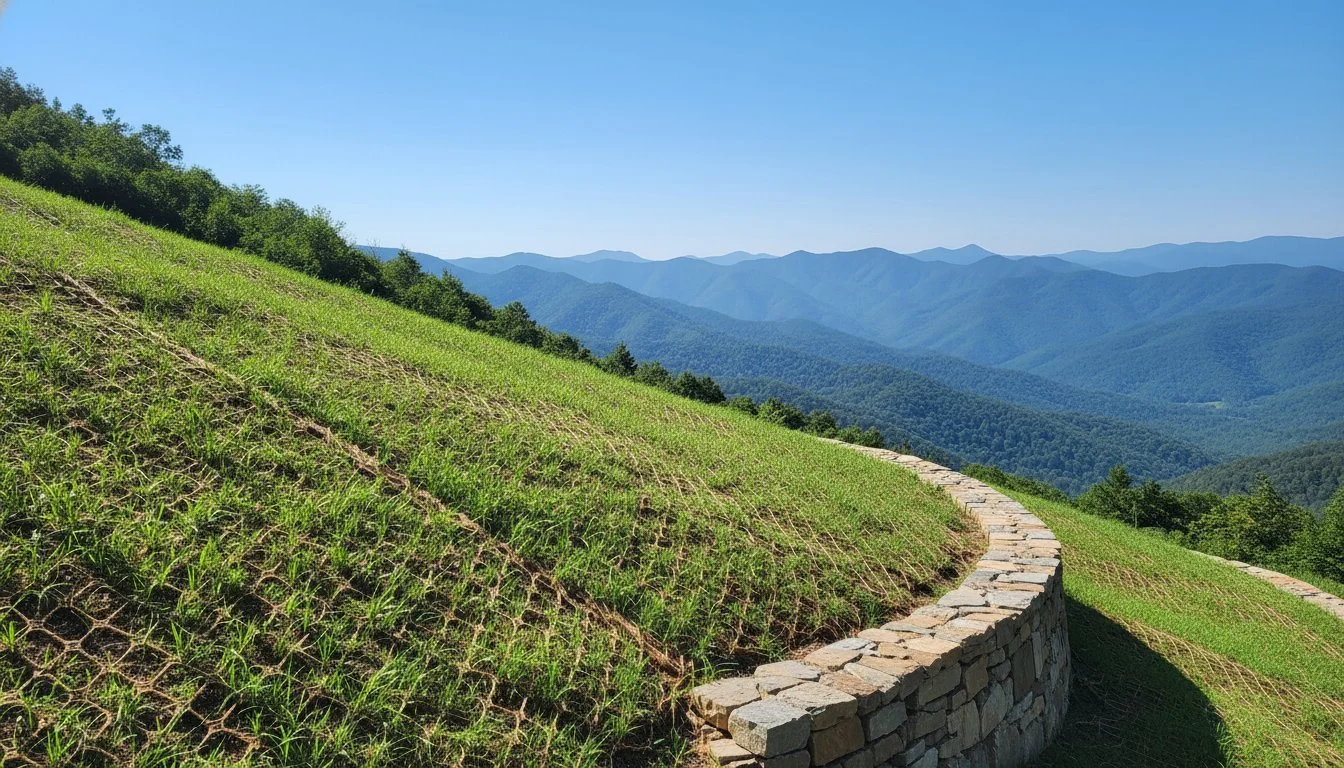
After the record-breaking rainfall events across Western North Carolina in late 2024, many property owners watched years of landscaping wash into the Watauga River in a single afternoon. It's a frustrating reality for anyone managing steep terrain in the High Country. If your mulch ends up in the driveway every time a mountain storm rolls through, you understand that high-altitude living requires specialized tools. Securing the right erosion control supply is the first step toward stabilizing your land and protecting the local trout streams that define our region.
You've likely realized that standard retail options don't hold up against a 30 percent grade or rocky, thin soil. We agree that property maintenance should focus on long-term stability rather than constant, expensive repairs. This guide will help you master the essential supplies and strategies for stabilizing steep slopes and managing runoff effectively. We'll examine industrial-grade geotextiles, hydroseeding solutions, and drainage systems designed specifically for the Boone climate to ensure your landscape remains secure for the 2026 season and beyond.
Key Takeaways
Understand why Boone’s steep topography requires specialized stabilization materials to manage heavy mountain runoff and prevent soil loss.
Navigate our comprehensive inventory to find the ideal erosion control supply for your project, including blankets, wattles, and logs tailored for varying slopes.
Evaluate the performance differences between hardscape solutions like riprap and bio-engineering methods to ensure your drainage channels remain secure.
Apply the "Critical Grade" framework to accurately assess slope severity and choose the most reliable materials for driveways, gardens, or creek beds.
Learn how local sourcing provides the logistical advantage of materials specifically engineered for the unique climate and terrain of the High Country.
Understanding Erosion Control Supply in the High Country
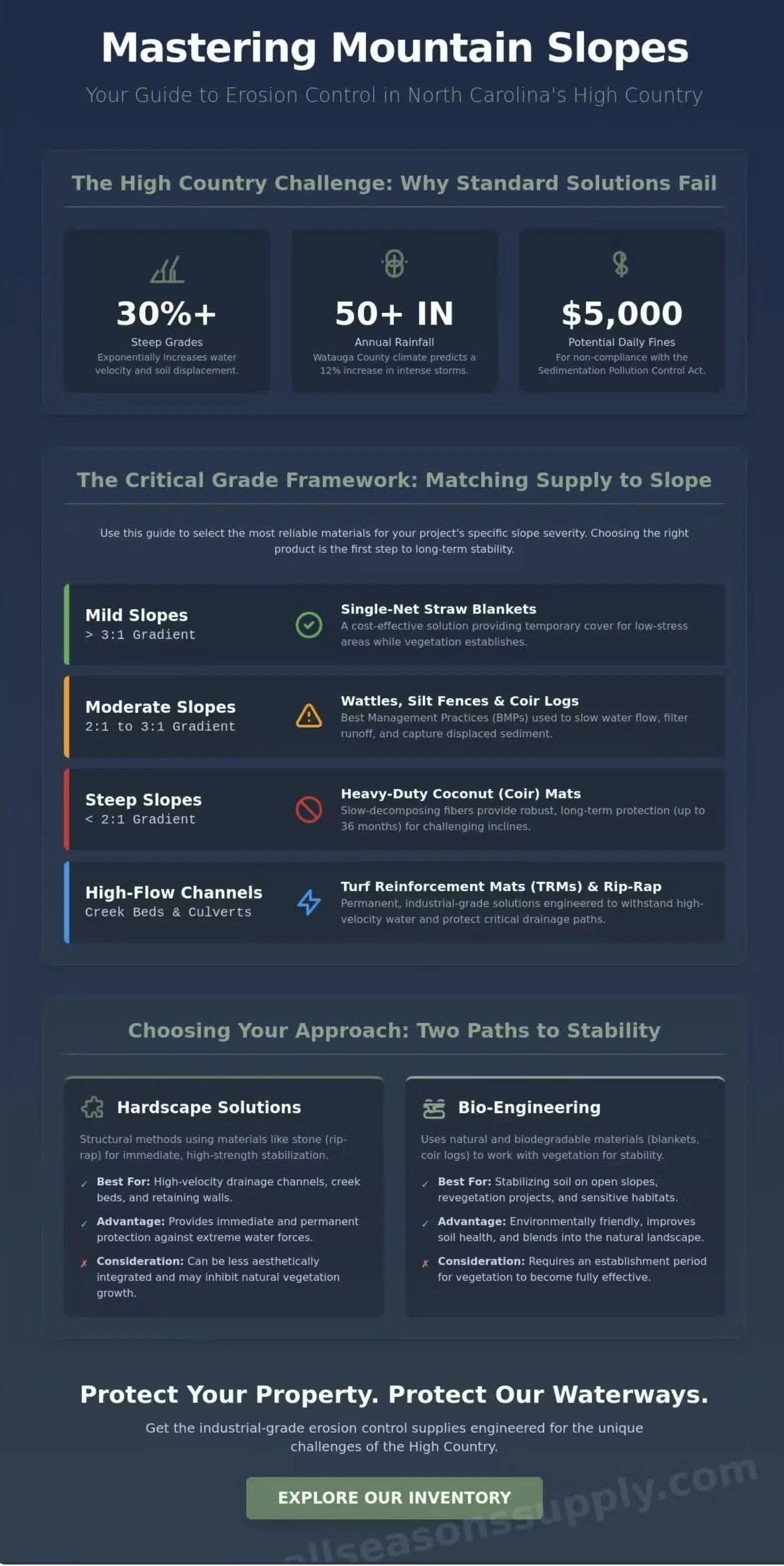
Erosion control supply refers to a specialized inventory of engineered materials designed to stabilize disturbed soil, manage high-velocity water runoff, and facilitate the establishment of permanent vegetation. In Boone, these tools are not optional extras; they are essential infrastructure for any land-disturbing project. The 2026 weather outlook for Watauga County predicts a 12% increase in high-intensity storm events compared to the previous five-year average. This shifting climate requires property managers to adopt a more robust strategy than is required for standard lowland projects, because mountain slopes accelerate water runoff at dangerous rates.
Managing a site in North Carolina involves strict adherence to the Sedimentation Pollution Control Act of 1973. This law mandates that any land-disturbing activity must implement effective measures to prevent silt from entering local waterways. In the High Country, where many properties sit adjacent to protected trout streams, the environmental stakes are high. Failure to maintain proper on-site erosion control supplies leads to project shutdowns and potential fines of up to $5,000 per day. For those seeking foundational knowledge of these systems, this comprehensive guide to erosion control provides an overview of global principles we adapt to our local Appalachian terrain.
The Science of Mountain Soil Loss
Gravity is the primary driver of soil displacement in Boone. When water moves down a 30% grade, its velocity increases exponentially, stripping away the thin layer of topsoil common in our region. Watauga County soils often contain high rock content, which helps with deep stability but does little to prevent surface rilling during heavy downpours. Property owners should look for "rills," or small channels forming in the dirt, as these are early indicators that current stabilization measures are failing. High-altitude precipitation, often exceeding 50 inches annually in Boone, creates a constant cycle of freeze-thaw that further loosens soil particles.
Key Terminology for Property Owners
Effective site management requires understanding the distinction between erosion control and sediment control. Erosion control prevents soil from moving in the first place, while sediment control captures soil that has already been displaced. Professional erosion control supply strategies utilize both to ensure site compliance.
BMPs (Best Management Practices): These are state-approved technical methods for controlling runoff and protecting water quality on construction sites.
Temporary Stabilization: Short-term solutions like straw mulch or wood fiber blankets are used during active construction phases.
Permanent Stabilization: Long-term inventory such as turf reinforcement mats (TRMs) or rip-rap stone designed for multi-year durability.
All Seasons Supply focuses on providing the right materials to meet these specific mountain challenges. We prioritize reliability and inventory depth so that your project remains compliant and your soil stays in place, regardless of the season.
Essential Erosion Control Materials for Boone Projects
Selecting the right erosion control supply inventory requires an understanding of the specific terrain in the Blue Ridge Mountains. Boone's 3,333-foot elevation and average annual rainfall of 52 inches create unique challenges for soil stability. Contractors must choose materials that withstand high-velocity runoff and steep gradients to prevent site failure. Proper material selection ensures compliance with local Watauga County regulations and protects the long-term integrity of the landscape.
Blankets and Mats: Your First Line of Defense
Erosion Control Blankets (ECBs) provide immediate cover for disturbed soil. For mild slopes with a 3:1 gradient, single-net straw blankets offer a cost-effective solution for temporary stabilization. Steeper inclines or areas with high water concentrations require heavy-duty coconut mats. These coir fibers decompose slowly, providing protection for up to 36 months while vegetation establishes.
Environmentally sensitive projects near High Country streams benefit from 100% biodegradable blankets. These products eliminate plastic netting, preventing wildlife entanglement in delicate ecosystems. In high-wind areas like Beech Mountain, where gusts often exceed 60 mph, pinning techniques are critical. Use a density of 1.5 to 2.5 staples per square yard to ensure the matting remains in direct contact with the soil. This prevents "tenting," which allows water to flow underneath the material and cause hidden rills. Aligning your installation with EPA's Best Management Practices ensures your site meets federal sediment-control standards.
Sediment Barriers: Wattles and Silt Fences
Wattles and silt fences serve as the primary defense against sediment migration. Straw and coir wattles work by slowing down runoff and spreading it over a wider area. They don't act as dams; instead, they filter water while dropping sediment on the uphill side. This is particularly effective for perimeter protection during driveway expansions in Blowing Rock, where space is often limited by existing trees.
Standard Silt Fence: Best for flat areas with low-volume sheet flow.
Wire-Backed Silt Fence: Necessary for heavy mountain runoff and steep slopes where water pressure can tear standard fabric.
Geotextiles: Woven fabrics provide high tensile strength for under-stone stabilization, while non-woven options are preferred for drainage applications.
Maintenance remains a non-negotiable part of the process. Clear sediment once it reaches 50% of the barrier's height to prevent structural failure. When you need a reliable erosion control supply partner, All Seasons Supply delivers the inventory needed to maintain site integrity and operational continuity year-round. We prioritize durable materials that withstand the rigorous demands of mountain construction.
Hardscape vs. Bio-Engineering: Choosing the Right Solution
Mountain properties in Boone require a dual approach to manage heavy runoff. Structural solutions provide immediate stabilization, while biological methods offer permanent security through natural growth. Finding the right erosion control supply depends on the specific grade of your slope and the velocity of water moving across it. We help you balance these two strategies to protect your investment and maintain the integrity of your land.
Stone and Gravel Solutions for Watauga County
Heavy rainfall in the High Country creates high-velocity runoff that can wash away loose soil in minutes. Accessing a landscape stone supplier in Vilas, NC, is the first step in creating a durable defense. ABC stone provides a compacted, stable base for high-traffic areas and driveway repairs. It creates a solid foundation that resists shifting under the weight of vehicles or heavy rain.
For steep gullies and culvert outlets, riprap sizing is critical. Class 1 riprap, which includes stones between 5 and 12 inches, effectively breaks the energy of rushing water. If the water volume is higher, Class 2 riprap may be necessary to prevent the stones themselves from being displaced. River rock offers a functional alternative for drainage swales. It manages runoff effectively while providing a polished look that fits the mountain aesthetic. These stone solutions provide the heavy-duty weight needed to keep soil in place during 3-inch rain events.
Vegetative Stabilization: The Long-Term Fix
While stone handles the force, plants provide the endurance. Choosing nursery plants, Blowing Rock allows you to install species with deep, aggressive root systems that act as a living anchor. Native shrubs like Fragrant Sumac or Red-osier Dogwood thrive in mountain soil. They create a subterranean mesh that binds dirt together, preventing the deep-seated slides common in Watauga County.
For areas requiring new turf or groundcover, a layered approach is most effective. Mixing nutrient-dense topsoil near me with wood-fiber erosion blankets keeps the foundation steady while seeds germinate. This combination ensures that your erosion control supply doesn't wash downhill before the plants can establish themselves. Successful stabilization often involves these specific steps:
Identify the water flow path to determine where stone is mandatory.
Apply a layer of high-quality topsoil to provide a growth medium.
Install erosion blankets or jute matting over seeded areas.
Plant deep-rooted shrubs in a staggered pattern to break up sheet flow.
Immediate buffers like mulch and pine straw serve as the first line of defense. Pine straw is especially useful on steep Boone slopes because its individual needles interlock, preventing the layer from sliding. These organic materials protect the soil surface from raindrop impact while your permanent vegetation matures. This integrated approach ensures your landscape remains stable through every season.
A Selection Framework for Mountain Erosion Projects
Selecting the right erosion control supply requires a technical assessment of your property's topography. The most important metric to identify is the "Critical Grade." Any slope with a 3:1 slope or steeper requires professional-grade stabilization rather than simple seeding. A 3:1 grade means the elevation changes one foot for every three feet of horizontal distance. At this pitch, gravity and rainfall velocity overcome the soil's natural friction, leading to rapid gully formation during Boone's frequent heavy rain events.
Estimating materials for mountain lots requires accounting for irregular contours. While flat land calculations are straightforward, high-country projects often require a 15% overage buffer for overlaps and anchoring trenches. For every 1,000 square feet of coverage, plan for 1.5 rolls of standard 4-foot matting and approximately 200 landscape staples. This ensures the material stays flush with the soil, preventing "tenting" that can allow water to flow beneath the barrier.
A professional-grade installation relies on specific hardware to withstand the elements. You'll need 6-inch or 8-inch steel staples to secure blankets, especially in the rocky soil typical of the Blue Ridge. Trenching shovels are necessary to "key in" the top edge of your matting into a 6-inch-deep anchor slot. This simple step prevents the entire installation from sliding down the mountain during a saturated freeze-thaw cycle.
Project Scenario 1: Steep Driveway Runoff
High-velocity runoff quickly strips a mountain driveway down to the subgrade. To manage this, combine screenings with ABC stone to create a compacted, interlocking surface that resists water penetration. Along the shoulders, coir wattles serve as effective sediment traps. A check dam is a small barrier constructed across a swale or drainage ditch to reduce the velocity of concentrated water flows on mountain roads. These structures turn a destructive torrent into a series of manageable pools, protecting your road investment from washouts.
Project Scenario 2: New Garden Beds on a Slope
Establishing vegetation on Avery County inclines presents the challenge of frost heave. This occurs when soil expands during 30-degree temperature swings, pushing young root systems out of the ground. Bulk mulch delivery in Boone, NC, provides the insulation needed to stabilize soil temperatures and protect root integrity. For slopes between 4:1 and 3:1, layer biodegradable netting over the mulch. Pine straw acts as a natural weaver; its interlocking needles create a physical mat that holds firm during heavy spring rains while allowing plants to emerge. This integrated approach ensures your erosion control supply strategy supports long-term landscape health.
Secure the reliability your property needs by ordering your complete erosion control solutions from All Seasons Supply.
Sourcing Erosion Control Supply in Boone and Beyond
Securing the right erosion control supply requires more than just picking up a roll of netting. In the High Country, elevation changes and high annual rainfall create unique challenges for soil stability. Standard products designed for flat terrain often fail during a typical North Carolina mountain storm. We provide materials engineered specifically for elevations of 3,000 feet or higher. Reliability is the foundation of every project we support.
Why Local Inventory Matters
Big-box retailers stock generic products that don't account for the steep slopes of Watauga County. These standard-duty blankets often tear under the weight of heavy mountain runoff. We maintain an inventory of DOT-spec materials that meet local permit requirements for residential and commercial sites. Selecting the correct grade of stone or geotextile is a critical step in your spring landscape checklist. Using the wrong material results in costly rework and potential fines from local environmental inspectors. Our inventory includes heavy-duty coir logs and double-net straw blankets that provide the durability required for 45-degree grades.
Partnering with All Seasons Supply
We function as a comprehensive partner for both independent contractors and homeowners. Our facility serves as a one-stop shop where you can secure stone, soil, blankets, and nursery stock in a single visit. This integrated approach saves time and reduces the logistical complexity of coordinating multiple vendors. We understand that mountain roads present hurdles. Our delivery fleet is equipped to transport bulk stone and heavy rolls to remote sites across Boone, Blowing Rock, and Banner Elk. We don't just drop off materials; we ensure they arrive where they're needed most.
Expert consultation is included with every order. With over 50 years of local experience, our team understands the specific soil compositions of the Blue Ridge Mountains. We help you choose the right erosion control supply based on your site's specific drainage patterns and slope. Whether you're a contractor managing a large-scale development or a homeowner protecting a garden bed, we provide the steady guidance needed for long-term stability. Contact our team today to discuss your project requirements and schedule a delivery that keeps your operation moving forward.
Protect Your High Country Investment
Managing mountain terrain requires a strategic approach that balances immediate stabilization with long-term ecological health. You've learned how to distinguish between residential-grade materials and DOT-spec requirements, ensuring your project meets the strict 2026 standards expected in the High Country. Selecting the right erosion control supply is the difference between a landscape that washes away and one that stands firm against heavy Appalachian rainfall. All Seasons Supply brings over 50 years of combined High Country landscaping experience to every order, providing the technical expertise needed for complex slope management. We maintain a full inventory of stabilization materials and offer local delivery to Boone, Blowing Rock, and surrounding mountain communities. This local presence ensures your project stays on schedule regardless of the season. Whether you're a facility manager or a homeowner, having a dependable partner makes the procurement process predictable and efficient. Secure your property today with professional erosion control supplies from All Seasons Supply. Your mountain landscape is an investment that deserves the highest level of protection and care.
Frequently Asked Questions
What is the best erosion control for a very steep mountain slope?
High-performance Turf Reinforcement Mats (TRMs) are the most effective solution for steep mountain slopes in Watauga County. These mats provide 3,000 lbs/ft² of tensile strength to hold soil in place during heavy rainfall. You'll achieve the best results by combining TRMs with deep-rooted native grasses. This integrated approach ensures the slope remains stable even when the grade exceeds 2:1.
Do I need a permit for erosion control on my Boone property?
You need a permit if your project disturbs more than 2,500 square feet of land or is located near protected water sources. The Watauga County Planning and Inspections Department enforces these rules under the NC Sedimentation Pollution Control Act of 1973. It's vital to secure your permits before moving any dirt. This step prevents costly work stoppages and ensures your project meets local environmental standards.
Can I use regular mulch for erosion control on a hillside?
Standard wood mulch isn't suitable for steep hillsides because it floats and washes away during 1-inch rain events. Instead, use shredded hardwood or "gorilla hair" mulch that interlocks to form a stable mat. For professional results, we recommend an erosion-control supply solution, such as wood fiber blankets. These blankets provide 100% ground cover and won't migrate down the slope like loose mulch does.
How long do biodegradable erosion control blankets last?
Biodegradable erosion control blankets typically last 12 to 24 months, depending on their material composition. Straw blankets are a cost-effective choice for 12-month projects, while coir mats provide up to 36 months of stability. This timeframe allows permanent vegetation to establish a root system strong enough to hold the soil in place. Choosing the right material ensures you don't have to reapply products before your grass is fully grown.
What is the difference between a wattle and a silt fence?
A wattle is a flexible tube that filters water, whereas a silt fence acts as a vertical barrier to pond water. Wattles are usually 9 to 12 inches in diameter and work well on uneven mountain terrain. Silt fences require trenching and are better suited to flat areas where water can pool. Using both in a tiered system provides a comprehensive solution for managing sediment runoff on your site.
Is riprap better than vegetation for stopping erosion?
Riprap is superior for high-velocity drainage channels, but vegetation is more effective for stabilizing large, open slopes. Class B riprap stone handles the intense shear stress found in ditches and culvert outlets. Vegetation is a long-term solution that lowers soil temperature by 10 degrees and increases water absorption. We often recommend a hybrid approach to ensure complete protection across different landscape features.
How do I protect my new plantings from washing away in a storm?
Use jute netting or coir logs to anchor your topsoil and prevent new plantings from washing away. Secure the netting with 6-inch metal staples every 2 feet to keep it flush with the ground. This method reduces soil loss by 90% during heavy storms. It's a dependable way to protect your investment in seed and nursery stock until they take root.
Where can I get erosion control supplies delivered in Watauga County?
All Seasons Supply offers direct delivery of erosion control supplies throughout Boone and Watauga Counties. We maintain a steady inventory of blankets, wattles, and seed to keep your mountain project moving. Our delivery service covers Blowing Rock, Valle Crucis, and Deep Gap. Relying on our logistical support means you'll have the right materials on-site exactly when your crew needs them.