The Best Potting Soil for Boone & the High Country: 2026 Buying Guide
Why do container gardens that thrive in the Piedmont often fail by mid-July in the High Country? The reality is that standard potting soil isn't engineered to withstand the 40-mile-per-hour winds at Beech Mountain or the 50-inch average annual rainfall recorded in Blowing Rock. You likely already know that gardening at an average elevation of 3,333 feet requires more than just a green thumb; it demands a technical understanding of drainage and nutrient density. High-elevation environments present unique logistical challenges that can quickly turn a premium planter into a compacted, waterlogged mess.
We understand that your investment in nursery stock and seasonal color deserves a stable foundation to ensure long-term success. This 2026 guide provides a complete solution for selecting the right growing media to ensure your Avery County vegetable harvests remain productive throughout the short 110-day frost-free window. You'll learn how to identify professional-grade mixes that prevent soil compaction during heavy mountain rains and maintain moisture during dry, high-altitude spells. We examine the specific components that differentiate a reliable potting soil from a temporary fix. This ensures you achieve consistent, vibrant results from your first planting in May through the final autumn frost.
Key Takeaways
Understand why the High Country's unique elevation requires a specialized soilless medium to prevent container garden failure.
Identify the essential roles of perlite and vermiculite in providing superior drainage and aeration in mountain climates.
Learn the critical weight and density differences between bulk topsoil and premium potting soil to select the correct foundation for your project.
Discover a practical selection framework to match specific soil components with your plant types and container sizes for optimal growth.
See how sourcing professional-grade materials locally ensures the reliability and consistency needed for successful High Country landscaping.
Understanding Potting Soil: Why High Country Containers Need Special Care
Success in High Country gardening begins with a foundation that can withstand the rigors of our mountain environment. Understanding Potting Soil is the first step toward maintaining healthy containers in Boone’s unpredictable climate. Unlike the heavy, inorganic soil found in the ground, a high-quality potting soil is actually a "soilless" medium. It's engineered with components such as peat moss, aged pine bark, and perlite to provide the aeration and drainage container-bound roots require to survive. All Seasons Supply approaches growing media as a critical business tool for facility managers and professional growers. We provide solutions that account for the unique physiological stressors of high-altitude environments. High-altitude winds in the Blue Ridge Mountains can strip moisture from a container in under four hours. This accelerated evaporation rate makes a reliable, moisture-retentive mix essential for operational continuity. Our goal is to be your industrious partner, ensuring your landscaping remains vibrant despite local environmental pressures.
The High Country Climate Challenge
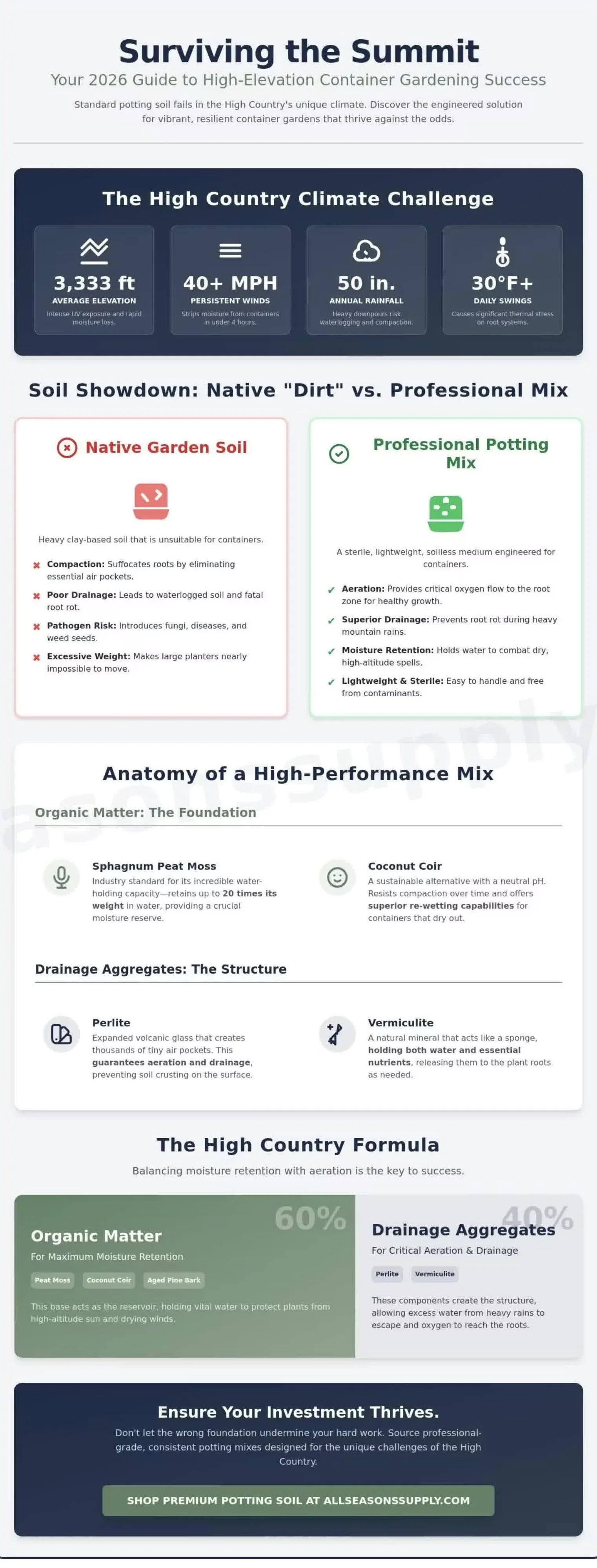
The High Country growing season occurs within USDA Hardiness Zones 6a to 7a, a range that demands extreme resilience from every plant. In high-elevation pockets like Foscoe, rapid temperature swings of 30 degrees can occur within a single afternoon, causing significant thermal stress to root systems. Proper drainage is a life-or-death factor during heavy spring rains in Watauga County. Without a professional-grade mix, containers quickly become waterlogged. This leads to immediate plant failure and wasted inventory.
Why "Dirt" from Your Yard Won’t Work
Native mountain soil is primarily composed of heavy clay, which is far too dense for container use. It lacks the necessary pores for oxygen to reach the root zone. Using unsterilized garden soil also introduces pathogens, fungi, and weed seeds, compromising your investment. Compaction is the primary risk when using native soil in pots.
Oxygen Deprivation: Clay particles pack together, suffocating roots.
Pathogen Risk: Garden soil can harbor Pythium and other root-rot fungi.
Weight Issues: Native soil is significantly heavier than soilless media, making large containers difficult to move.
Essential Components: What Makes a High-Performance Potting Mix?
A reliable potting soil serves as the primary infrastructure for container gardening in the High Country. It isn't just dirt; it's a precision-engineered medium designed to manage moisture and oxygen in a confined space. Sphagnum peat moss has long been the industry standard for its high water-holding capacity and acidic nature. However, many 2026 formulations now incorporate coconut coir. Coir provides a more neutral pH and maintains its structure longer than peat, which often compresses over time and restricts root growth.
To ensure operational success in mountainous climates, drainage aggregates such as perlite and vermiculite are mandatory. Perlite is a volcanic glass that creates air pockets, while vermiculite is a silicate that holds both water and minerals. Understanding the Essential Components of Potting Mix helps growers select products that sustain plant health through the unpredictable Appalachian spring. Additionally, high-quality mixes include wetting agents. These surfactants prevent soil from becoming hydrophobic, a common issue in which dry soil repels water rather than absorbing it during the first irrigation of the day.
Moisture Retention vs. Aeration
The ideal potting soil for Boone typically follows a 60:40 ratio of organic matter to drainage aggregates. This balance is critical because the intense UV exposure in Blowing Rock can quickly cause soil to crust on the surface. Perlite prevents this by breaking up the surface tension and allowing water to reach the root zone. While peat moss can hold up to 20 times its weight in water, coconut coir offers superior re-wetting capabilities. This ensures that containers don't remain bone-dry after prolonged exposure to high-altitude sun, maintaining a steady environment for sensitive root systems.
Nutrient Density and pH Balance
Most mountain-hardy plants thrive in a slightly acidic environment, typically between 5.5 and 6.5 pH. High-performance mixes achieve this through a blend of composted forest products and slow-release fertilizers. These fertilizers provide a steady stream of nitrogen, phosphorus, and potassium over a 90-day period. This timeline is essential for the High Country's compressed growing season. Trace minerals like iron and magnesium are also included to ensure vibrant blooms and deep green foliage. For facility managers overseeing large-scale landscaping, sourcing consistent supply solutions ensures every container remains vibrant throughout the season.
Potting Soil vs. Topsoil: Choosing the Right Foundation in Watauga County
Successful landscaping in the High Country starts with selecting the correct medium for the specific application. Bulk topsoil and premium potting soil serve distinct purposes; using them interchangeably often leads to plant failure or unnecessary expense. Topsoil is a mineral-based product composed of sand, silt, and clay. It is heavy, weighing approximately 2,200 pounds per cubic yard. In contrast, potting soil is a lightweight, sterile medium designed specifically for aeration and moisture retention in confined spaces. Choosing the right foundation is about protecting your investment. High-quality nursery stock, such as mature rhododendrons or Japanese Maples, represents a significant financial commitment. Using inferior, compacted soil to save on upfront costs often leads to root rot or stunted growth in the first two seasons. Premium soil provides the drainage and nutrient availability these plants need to survive the transition to your property, ensuring your landscape thrives long-term.
When to Use Bulk Topsoil
Bulk topsoil is the standard solution for large-scale land management. It provides the necessary structure for lawn leveling and filling deep garden beds where volume is the primary requirement. For property owners in Vilas or Foscoe with steep grades, topsoil serves as a stabilizing agent, improving drainage and preventing erosion. While it's cost-effective for these ground-based projects, its density makes it unsuitable for containers. For these larger landscape renovations, refer to our bulk topsoil guide for Boone, NC, to determine the exact volume required for your project.
When Only Potting Soil Will Do
Container gardening requires a specialized environment that topsoil cannot provide. Typical ingredients in a potting mix
Application Guide: Selecting Soil for Your Specific Mountain Project
Successful gardening in the High Country requires a strategic approach to soil selection. Your choice of potting soil should align with both the plant species and the environmental exposure of your property. For the hardy nursery plants Blowing Rock homeowners depend on, drainage is the primary concern. Perennials and shrubs require a denser structure to anchor roots against mountain gusts, while indoor tropicals need a porous, peat-based medium to prevent root rot in lower light conditions.
In Banner Elk, vegetable gardening in raised beds often demands a custom blend. Using 100% bagged soil for a 12-inch deep bed is inefficient. Instead, a 60/40 ratio of bulk organic matter to premium soil provides the necessary nutrient density for short mountain growing seasons. This balance ensures that crops like kale and carrots have the structural support and drainage required to withstand unpredictable spring frosts.
Hanging Baskets and Window Boxes
High Country winds often reach sustained speeds of 20 mph during spring storms. Lightweight mixes are essential to prevent hardware failure and structural damage to porch eaves. These airy mixes dry out quickly, so look for products containing moisture-retaining crystals or hydrogels. These additives can reduce watering frequency by 50 percent during the dry weeks of July. For aggressive bloomers like petunias, choose a 10-10-10 slow-release fertilizer mix to sustain heavy flowering through the end of August.
Raised Beds and Large Estate Planters
Filling deep estate planters requires a cost-effective strategy known as the lasagna method. Layer the bottom 40 percent of the container with coarse organic materials, such as untreated wood chips or pine bark. This improves drainage and reduces the total volume of potting soil required. Top this with a blend of bulk compost and high-quality potting medium. This combination ensures long-term soil structure for perennial shrubs, which can remain in the same planter for 3 to 5 years before requiring a full soil refresh. This method provides the stability needed for larger specimens while maintaining a nutrient-rich environment for root development.
Shop our complete inventory of professional-grade soil solutions to ensure your mountain project thrives this season.
Why All Seasons Supply is Your Partner for Premium Potting Soil in Boone
Successful mountain gardening requires more than just seeds and water. It demands professional-grade materials that withstand the volatile climate of the Blue Ridge. All Seasons Supply serves as the steady partner for contractors and residents, providing the reliable inventory needed to keep projects on schedule. Our team brings 50 years of combined experience in mountain gardening to every interaction, ensuring you receive products that actually work in our unique environment. We provide premium potting soil designed to support healthy root development in high-altitude conditions. Once your planting is complete, we offer bulk mulch delivery in Boone, NC, to provide the essential finishing touch and moisture retention your beds require.
Buying local matters in the High Country. Materials sourced from outside the region often fail to account for our specific soil acidity and drainage needs. We prioritize inventory that is tested for local performance. This focus on reliability ensures that your landscape remains resilient against the heavy rainfall and rapid temperature shifts common in Watauga County. We act as an industrious partner, working in the background to ensure your facility or home landscape remains in peak condition throughout the growing season.
Expert Consultation and Local Knowledge
Our staff prioritizes practical solutions over simple transactions. We help you calculate the exact volume of potting soil needed for your specific project, whether you're filling 20 raised beds or a single commercial planter. This precision prevents waste and keeps your budget on track. We only stock materials that are proven to be High Country hardy. This commitment ensures your investment survives the late frosts and heavy rain cycles typical of the region. Every recommendation is grounded in five decades of local expertise, giving you the confidence that your landscape will thrive. We don't just sell bags; we provide the foundation for long-term growth.
Convenient Delivery Across the High Country
Logistics shouldn't be the bottleneck for your landscaping goals. We maintain a fleet of delivery vehicles to service Boone, Blowing Rock, and Banner Elk with consistent precision. Our integrated ordering system allows you to combine bulk soil with stone and mulch in a single delivery, streamlining your procurement process. This efficiency saves time and keeps your job site organized. We understand our clients' operational timelines and move at a calm pace, ensuring we're never caught off guard by changing demands. Our delivery team respects your property and your schedule, ensuring materials are placed exactly where they're needed. Contact us today for a bulk soil delivery quote!
Elevate Your High Country Planting Strategy
Success in Watauga County's unique climate requires more than standard garden soil. High-performance potting soil provides the essential drainage and nutrient retention needed for container plants to thrive in high-altitude environments. By selecting professional-grade mixes over basic topsoil, you're ensuring your mountain projects remain healthy throughout the 2026 growing season. All Seasons Supply brings 50+ years of combined industry experience to every order, providing the stability and expertise your facility or landscape requires.
We're a locally owned and operated partner dedicated to keeping your operations running smoothly. Our team provides reliable delivery services across Watauga, Avery, and Ashe Counties, ensuring you have the materials you need exactly when you need them. We prioritize long-term relationships and practical solutions for every client we serve. Trust our industrious team to support your seasonal transitions with efficiency and quiet confidence.
Browse Our Professional Soil & Landscaping Supplies to secure the foundation for your next project. We look forward to helping your High Country landscape reach its full potential.
Frequently Asked Questions
Can I use potting soil in my garden beds in Boone?
You can use potting soil in garden beds, but it's not the most efficient solution for large-scale mountain landscaping. Potting soil is specifically engineered for container drainage and is often too lightweight for ground applications. Ground beds perform better with a 50% native soil and 50% organic compost mix, which provides the structural density needed for Boone's clay-heavy terrain.
How much potting soil do I need for a 12-inch hanging basket?
A standard 12-inch hanging basket requires approximately 8 to 10 quarts of potting soil to fill it properly. This specific volume provides enough space for the root systems of 3 to 5 annual plants to establish. Filling the basket to within 1 inch of the rim prevents water runoff and ensures your plants survive the intense 2026 summer sun.
Does potting soil expire or go bad if left outside?
Potting soil doesn't expire like food, but its physical properties degrade after 12 to 18 months of outdoor exposure. Moisture and UV rays break down the organic fibers, which reduces aeration by roughly 40%. For consistent results, it's best to replace any soil that's been sitting in open bags through two winter cycles to ensure proper root health.
What is the difference between organic and traditional potting soil?
The primary difference lies in the nutrient source: organic potting soil uses natural inputs such as bat guano or kelp, while traditional mixes use synthetic fertilizers. Traditional soils often provide a 90-day nutrient burst, whereas organic options build a sustainable ecosystem for your plants. Both varieties maintain the same lightweight structure required for container drainage in the High Country.
How do I prevent my potting soil from drying out in the High Country wind?
Select a potting soil blend with high concentrations of coconut coir or peat moss to maximize moisture retention against the wind. In Boone, where wind gusts often reach 20 miles per hour, adding a 2-inch layer of wood chips to your pots reduces evaporation rates by 30%. This simple step protects your inventory and reduces daily maintenance requirements for facility managers.
Should I add fertilizer to my new potting soil?
You shouldn't add fertilizer immediately if your potting soil already contains a 6-month slow-release formula. Most professional-grade mixes include enough nutrients to support initial growth for 60 to 90 days. Always verify the N-P-K ratio on the bag before adding supplements to avoid nutrient burn on young root systems during the early spring planting phase.
Is it better to buy bagged potting soil or bulk for raised beds?
Bagged potting soil is the best choice for portability, but bulk soil is 50% more cost-effective for raised beds larger than 100 square feet. Bulk solutions provide the heavy-duty structure needed for permanent outdoor installations at 3,300 feet of elevation. For smaller residential containers, the sterilized nature of bagged soil offers a more controlled environment for delicate flowers.
Can I reuse potting soil from last year’s containers?
You can reuse potting soil if the previous plants were healthy, and you supplement the old material with 30% fresh compost. Over a single season, soil loses its porosity and essential minerals. Refreshing the mixture ensures your 2026 plantings have the drainage and nutrient density they need to thrive despite the unpredictable weather patterns in Watauga County.