
How Much Mulch Do I Need? A High Country Calculation Guide for 2026
Ordering one cubic yard too little for a landscaping project in Watauga County often results in a second delivery fee that costs more than the mulch itself. You likely already know that guessing your garden's square footage leads to thin coverage or expensive leftovers. Calculating how much mulch I need becomes even more complex when you're managing the 15 percent grade changes common in Blowing Rock or the irregular perimeters of mountain beds. All Seasons Supply understands that your project timeline depends on precision and reliability.
We've developed this guide to help you master the math of bulk ordering for 2026. With it, you'll gain a clear shopping list in cubic yards. You'll also gain confidence that your selected depth will hold against High Country weather. We'll walk through the conversion from bags to bulk and adjust for sloped terrain. We'll also explain delivery logistics across Avery and Watauga Counties, ensuring your operations run smoothly. This roadmap provides the solutions you need for a consistent and professional landscape finish.
Key Takeaways
Break complex landscape beds down into simple geometric shapes to accurately calculate material volume and place a precise order.
Discover the specific depth adjustments required for High Country terrain to determine exactly how much mulch I need for optimal plant health and erosion control.
Choose bulk delivery for a more cost-effective, efficient solution than retail bags for large-scale mountain landscaping projects.
Prepare your site properly to ensure a professional and reliable delivery experience throughout Boone, Blowing Rock, and the surrounding areas.
The Importance of Precise Mulch Calculation in the High Country
Understanding exactly how much material your property requires is the first step toward a successful landscaping season. In the professional supply industry, we measure bulk mulch by the cubic yard. One cubic yard consists of exactly 27 cubic feet of material. Some property owners rely on the "eyeball method" to estimate their needs. This lack of precision often leads to unnecessary expenses or inadequate coverage. At All Seasons Supply, we function as your industrious partner. We prioritize exact data to ensure your operations remain efficient and your budget stays intact. Understanding what mulch is and how it interacts with our specific environment is crucial for any Boone facility manager. Proper depth is especially vital in the High Country. Heavy rainfall can cause significant soil erosion on sloped terrains if the mulch layer is too thin to anchor the ground.
Precision isn't just about aesthetics; it's about operational continuity. When you ask yourself, "How much mulch do I need?" before starting a project, you're planning for the health of your entire landscape. We provide the tools and expertise to move you from a rough guess to a concrete solution, ensuring your yard is protected against the volatile weather patterns common to the Blue Ridge region.
The Consequences of Under-Ordering
Ordering too little material creates immediate operational gaps. When you leave the Watauga County soil exposed, weed germination increases because sunlight reaches dormant seeds in the earth. During dry spells in the Blue Ridge Mountains, thin mulch layers allow moisture to evaporate quickly, stressing local vegetation and increasing your irrigation requirements. You might find yourself asking, "How much mulch do I need?" only after the delivery truck has left. This leads to the hidden cost of "short-load" delivery fees. Paying for a second, smaller delivery to top off a job significantly increases your price per yard and disrupts your project timeline.
The Risks of Over-Mulching (The Mulch Volcano)
Excessive mulch is just as damaging as an insufficient layer. When mulch exceeds 4 inches in depth, it begins to suffocate the root systems of local nursery trees by preventing essential oxygen exchange. Deep piles also retain too much moisture against the trunk, creating ideal habitats for wood-boring pests and fungal pathogens near your home or commercial foundation. A mulch volcano is a common but harmful landscaping error where mulch is piled high against the base of a tree trunk in a cone shape. To avoid this, you must account for a consistent 2 to 3-inch depth across your entire landscape bed. This precision protects your plant inventory and maintains the professional appearance of your High Country property.
Step-by-Step: Measuring Your Landscape Beds for Bulk Delivery
To accurately answer the question "how much mulch do I need," you must follow a systematic approach to measurement. Precision prevents material waste and ensures your landscape remains protected throughout the changing seasons. All Seasons Supply recommends a four-step process to determine your exact volume requirements.
Step 1: Divide your property into manageable segments. Most landscape beds in Watauga County are rectangular, circular, or triangular. Dividing complex layouts into these basic shapes simplifies the calculation process.
Use a standard tape measure to record each section’s length and width in feet. Round up to the nearest whole foot to preserve a safety margin for your inventory.
Step 3: Establish your desired depth. Standard applications usually range from 2 to 4 inches. When choosing the right mulch depth, remember a 3-inch layer is the industry standard. This depth provides effective weed suppression and moisture retention in Boone's variable climate.
Apply the master calculation formula: Multiply your total square footage by the depth in inches, then divide that sum by 324. This formula gives you the exact number of cubic yards required for your bulk delivery.
Calculating for Rectangular and Square Beds
Foundation plantings and straight-edged borders offer the most straightforward calculations. For instance, a bed measuring 10 feet by 20 feet provides 200 square feet of coverage. At a 3-inch depth, the formula (200 x 3 / 324) indicates you need 1.85 cubic yards. We recommend rounding up to the nearest half-yard. Ordering 2.0 yards ensures you have sufficient material to account for settling and uneven terrain across the site.
Estimating Irregular or Curved Garden Shapes
Many Blowing Rock estates feature kidney-shaped beds or curved borders. These shapes defy simple linear measurement. Use the Box Method for these areas. Measure the maximum length and maximum width as if the bed were a perfect rectangle. Multiply the result by 0.80 to account for the curves. This 20 percent reduction prevents significant over-ordering.
For circular beds around specimen nursery trees, measure from the trunk to the outer edge to find the radius. Multiply the radius by itself, then multiply by 3.14 to find the square footage. If you are measuring narrow perimeter borders, calculate the total length of the run. Multiply this by the average width. Accuracy at this stage ensures your landscape solutions arrive in the correct volume. That allows you to complete the project in a single, efficient delivery. This methodical approach provides the reliability you need during the busy growing season.

Choosing Your Depth: How High Country Conditions Affect Mulch Needs
Calculating the correct volume for your landscaping project depends on more than just square footage. When property owners ask, "How much mulch do I need?" the answer starts with selecting a depth that balances plant health with the specific demands of the High Country terrain. For most garden beds, a standard depth of 2 to 3 inches is ideal. This thickness provides enough coverage to suppress weeds and retain soil moisture while allowing oxygen to reach the root systems effectively.
Local topography plays a significant role in your calculations. Properties in Foscoe often feature steeper grades that are prone to erosion during heavy rainfall. On these inclines, applying a 4-inch layer of coarse mulch is a strategic choice. The heavier, larger pieces are less likely to wash away than fine-shredded varieties. Similarly, properties at higher elevations, such as Beech Mountain, require thicker layers for seasonal protection. Applying a 4-inch blanket in late October provides a necessary insulation barrier against the severe freeze-thaw cycles common in the Appalachian winter.
Material-Specific Depth Guidelines
Use hardwood mulch as a slope solution—shredded fibers interlock for stability. Maintain a consistent 3-inch depth to maximize wind and water resistance.
Pine Bark Mulch: Because pine bark has a higher "fluff" factor, it tends to settle more than hardwood. You should account for a 15 percent reduction in volume after the first few rains by applying it slightly thicker initially.
Apply a 2-inch layer of designer-colored mulch to achieve consistent color coverage, as long as you can’t see the underlying soil.
Soil and Plant Considerations
The age and type of your vegetation also dictate your depth requirements. When mulching newly installed nursery plants in Blowing Rock, it is vital to keep the mulch at least 2 inches away from the trunk or base. This practice prevents moisture buildup against the bark, which can lead to decay or pest issues. Fine-textured mulches require less depth than coarse wood chips to achieve the same level of soil protection.
Established shrubs with deep root systems can easily tolerate a 3-inch application. In contrast, shallow-rooted perennials require a lighter touch. For these smaller plants, a 1 to 2-inch layer is the maximum recommended depth to ensure the mulch does not bury the crown. By adjusting your volume based on these specific plant needs, you ensure your landscape remains healthy, and your maintenance remains efficient throughout the year.
Converting the Numbers: Cubic Yards, Bags, and Truckloads
Converting measurements into tangible quantities ensures your project remains on schedule and within budget. Many homeowners fall into the "Big Box" trap by purchasing individual bags from retail centers. This method often costs 300% more than purchasing bulk materials directly. When you calculate how much mulch you need, remember that one cubic yard equals 13.5 bags of the standard 2-cubic-foot size. Buying in bulk eliminates the need to handle dozens of plastic bags, streamlining your workflow immediately.
1 Cubic Yard: Roughly the size of a standard household washing machine.
5 Cubic Yards: A pile approximately 10 feet long, 10 feet wide, and 1.5 feet high.
10 Cubic Yards: Equivalent to 135 retail bags.
Visualizing Your Order
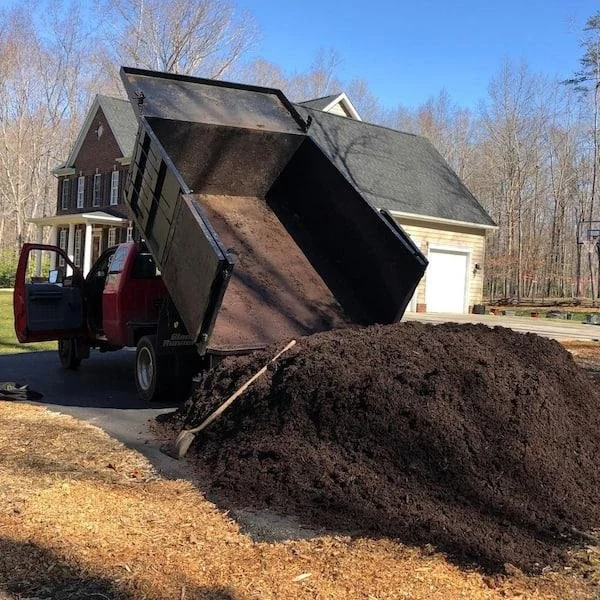
Visualizing a cubic yard is simple. It occupies the same physical space as a large domestic appliance. We use calibrated loader scoops to ensure every delivery meets the cubic yard standard precisely. This precision prevents the common frustration of running short mid-project. In a typical Banner Elk driveway, a 5-yard pile is manageable but requires clear space. To maximize efficiency, select a drop-off point that minimizes wheelbarrow travel. Reducing the distance between the pile and your garden beds can cut your total labor time by 30% on larger properties.
Bulk vs. Bag Cost Analysis
The financial difference between bulk and bagged mulch is substantial. Retail bags often cost three times as much per yard as our bulk alternatives. The break-even point for a professional delivery is generally 4 cubic yards. If your project exceeds this amount, bulk delivery becomes the most cost-effective solution for your budget. High-Country properties with expansive acreage benefit from the reduced labor required for bulk piles. You avoid the repetitive task of cutting open and disposing of 135 individual bags for every 10 yards of material. This choice also removes significant plastic waste from the waste streams of Watauga and Ashe counties. We provide the inventory and delivery reliability needed to keep your facility or home looking its best without unnecessary overhead. Deciding how much mulch I need is the first step toward a more efficient landscaping season.
Ready to streamline your next landscaping project with reliable bulk delivery?
View our mulch inventory and delivery solutions.
Streamlining Your Project with All Seasons Supply Delivery
Managing a landscaping project in the High Country requires more than just a basic calculator. While determining how much mulch I need is a critical first step, the logistics of getting that material to a mountain job site often present the real challenge. All Seasons Supply provides reliable delivery services throughout Boone, Blowing Rock, Banner Elk, and surrounding communities. We focus on ensuring your inventory arrives exactly when you need it, keeping your project on schedule despite the region's unpredictable terrain and weather.
Preparing your site for a bulk delivery is essential for operational efficiency. You should choose a flat, accessible drop-off location, ensuring it is clear of low-hanging branches or power lines that might obstruct our delivery trucks. Laying down a heavy-duty tarp before the driver arrives keeps your driveway clean and prevents the mulch from mixing with underlying gravel or soil. If your initial calculations for a bulk mulch delivery in Boone, NC, feel uncertain, our team is available to verify your numbers. We provide expert consultation to prevent over-ordering and costly delays caused by mid-project shortages.
Scheduling Your High Country Delivery
Timing your order is vital in the mountains. We recommend scheduling your application in early spring, ideally before the "Boone monsoon" rains typically arrive in late April and May. This ensures the mulch settles properly and provides immediate weed suppression before the growing season peaks. Our drivers are skilled at navigating narrow, winding mountain roads, but we ask that you confirm a minimum 12-foot width clearance for our equipment. Looking toward 2026, we remain committed to maintaining consistent inventory levels and dependable timelines so your seasonal maintenance never falters. Use our expertise to determine how much mulch I need before the spring rush begins.
The All Seasons Advantage
Our team brings over 50 years of combined experience to every interaction, providing a level of reliability that local facility managers and homeowners trust. We offer integrated solutions by pairing your mulch order with locally-grown hardy shrubs and perennials that thrive in our specific climate. This one-stop-shop approach simplifies your procurement process and ensures all materials are compatible with your landscape goals. We act as your industrious partner, working in the background to support your project's success. Contact All Seasons Supply today to secure a custom quote or to finalize your delivery schedule for the upcoming season.
Streamline Your High Country Landscape Project
Successful property maintenance starts with an accurate plan. By measuring your landscape beds and understanding the specific depth requirements for our local climate, you ensure your project stays on schedule and within its logistical bounds. Shifting from small-scale bags to bulk cubic yards provides the efficiency needed for large-scale results. When you finally answer the question of how much mulch you need, you've taken the most important step toward a professional, polished finish for 2026.
All Seasons Supply brings 50+ years of combined industry experience to your doorstep. We're a locally owned family business that prioritizes reliability and clear communication for every client. Our delivery network covers Watauga, Avery, and Ashe Counties, providing the consistent support you need to keep your operations running smoothly. We're here to serve as your steady partner in facility and landscape maintenance.
Get a Bulk Mulch Delivery Quote for Your High Country Project today. We're ready to help you get the job done right.
Frequently Asked Questions
How many bags of mulch are in a cubic yard?
There are 13.5 bags of mulch in a cubic yard if you're using the standard 2-cubic-foot size found at most retailers. If you purchase larger 3-cubic-foot bags, it takes exactly 9 bags to reach the same volume. Bulk delivery is a more efficient solution for Boone projects that require more than 15 bags, as it reduces plastic waste and simplifies the application process for professional crews.
How deep should I spread mulch for new flower beds?
You should spread mulch to a depth of 3 inches for new flower beds to ensure effective weed suppression and moisture retention. This specific thickness provides a reliable barrier against sunlight, which prevents approximately 90% of common weed seeds from germinating. For annual top-dressing on established beds, a 1-inch or 2-inch layer is usually sufficient to maintain a fresh appearance and consistent soil protection throughout the year.
What is the easiest way to calculate mulch for a circle?
The most accurate way to calculate a circular area is to multiply the radius by itself, then multiply by 3.14 and your desired depth. If your garden bed has a 10-foot diameter, your radius is 5 feet. Squaring that gives you 25, which you multiply by 3.14 to get 78.5 square feet. This calculation helps you determine how much mulch I need without over-ordering for curved landscape features.
Does mulch settle over time, and should I order extra?
Mulch typically settles by 20% to 25% within the first 4 months as the material compacts and begins to decompose. You should order an additional 10% more than your initial measurement to account for this natural compression. This ensures your 3-inch layer doesn't thin out to 2 inches after the first heavy rain in the High Country, maintaining the integrity of your landscape design.
How much area does 1 cubic yard of mulch cover?
One cubic yard of mulch covers 108 square feet when applied at a standard 3-inch depth. If you prefer a thinner 2-inch layer for established areas, that same cubic yard will cover 162 square feet. Knowing these coverage rates is vital for facility managers who need to maintain consistent aesthetics across large commercial properties or multi-unit residential complexes while managing a strict supply inventory.
Can I use a calculator for sloped areas in the High Country?
You can use a standard calculator for slopes, but you must increase your square footage estimate by 15% to account for the increased surface area of the incline. Slopes in the Boone area require this adjustment to ensure the coverage remains thick enough to prevent soil erosion. This simple calculation adjustment provides a reliable solution for difficult terrain and steep embankments that are common in our mountain environment.
What happens if I put down too much mulch?
Applying more than 4 inches of mulch can lead to root rot and oxygen deprivation for your trees and shrubs. Excessive layers create a hydrophobic barrier that prevents water from reaching the soil, often causing it to shed off the surface instead. To determine exactly how much mulch I need, stick to the 3-inch recommendation to keep your inventory costs low and your plant health high.