Top Soil Near Me: A Guide to High Country Garden Success in Boone, NC
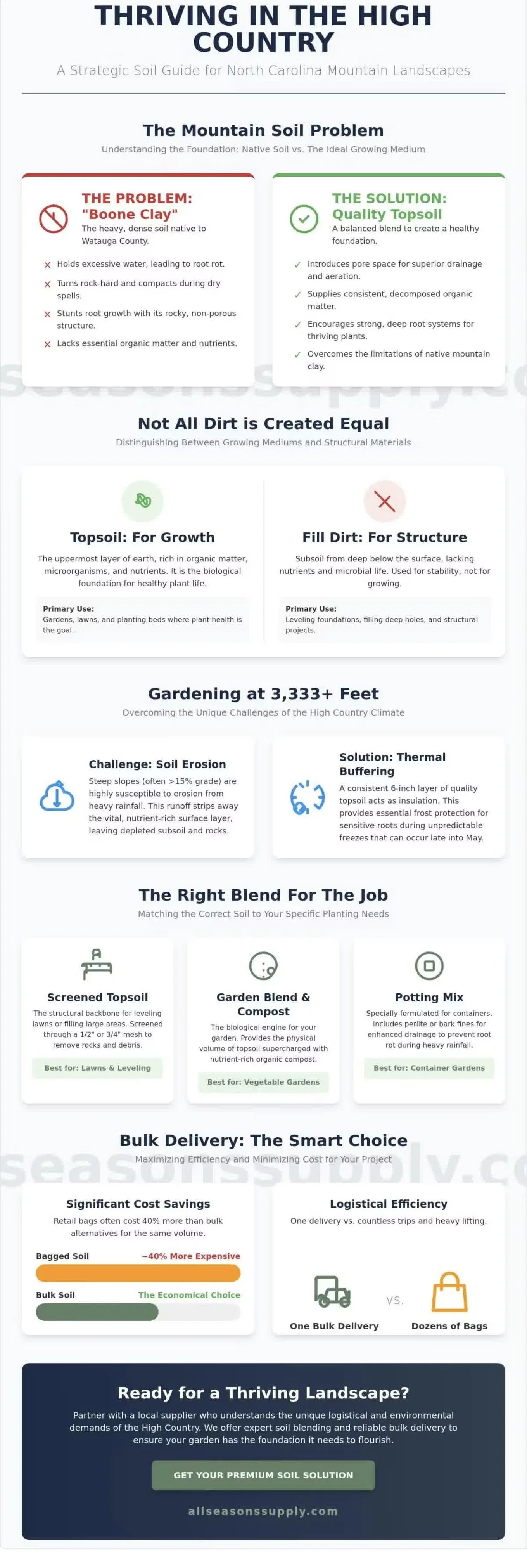
Successful gardening in the North Carolina High Country is less about your green thumb and more about your ability to overcome 500 million years of geological history. When you search for top soil near me, you aren't just looking for dirt; you're looking for a foundation that can withstand Boone's unique environmental pressures. You've likely experienced the frustration of heavy clay that holds too much water or rocky patches that break shovels and stunt root growth. Buying hundreds of retail bags is a logistical headache that often costs 40% more than bulk alternatives, yet doesn't provide the specific drainage your mountain property requires.
We understand that maintaining a landscape at an elevation of 3,333 feet requires a strategic approach to soil health. This guide provides professional solutions for selecting and using the right soil blends to ensure your garden thrives in our specific climate. You'll discover how to coordinate efficient bulk deliveries to challenging mountain locations and how to use expert soil blending to address poor drainage. We'll outline a clear path from your current logistical challenges to a reliable, lush landscape that enhances your property's value and your peace of mind.
Key Takeaways
Understand how to manage the dense "Boone Clay" common in the High Country to ensure your landscape has a healthy foundation.
Save on project costs by learning when to transition from bagged products to bulk topsoil near me for maximum efficiency.
Identify the specific differences between standard topsoil and nutrient-rich garden blends to match the right solution to your planting needs.
Master the site preparation and measurement techniques required for a seamless bulk delivery in Watauga County.
Partner with a dependable local supplier that understands the unique logistical and environmental demands of North Carolina mountain terrain.
What is Topsoil and Why Does the High Country Need It?
Successful landscaping in Western North Carolina begins with understanding the foundation of your garden. Topsoil is the uppermost layer of the earth, typically 5 to 12 inches deep. This specific layer contains the highest concentration of organic matter, microorganisms, and nutrients necessary for plant life. When you search for topsoil near me, you're looking for a solution to the biological limitations of our native terrain. Understanding what topsoil is reveals that its composition directly dictates the health of everything from your lawn to your ornamental shrubs.
Local gardeners frequently struggle with "Boone Clay," a term for the heavy, dense mountain soil found throughout Watauga County. This clay lacks porosity, meaning it lacks sufficient small spaces or pores between soil particles, which are necessary for healthy root systems. It stays saturated—meaning waterlogged—during our wet springs and turns rock-hard during dry summer spells. Quality topsoil solves this by introducing essential pore space, or gaps that let air and water flow more freely. This space allows for better aeration (the movement of air through the soil)
and drainage, ensuring that roots don't suffocate in the rocky, non-porous NC terrain. For High Country perennials and shrubs to thrive, they require a consistent supply of decomposed organic matter—fully broken-down plant and animal material—that native clay simply cannot provide on its own.
Topsoil vs. Fill Dirt: Knowing the Difference
It's vital to distinguish between functional growing mediums and structural materials. Fill dirt consists of subsoil taken from deep below the surface; it lacks the nutrients and microbial life needed for growth. Contractors use fill dirt for structural stability, such as leveling a foundation or filling a deep hole, because it doesn't settle or shift like organic soil. Accepting "free" dirt from local construction sites often introduces invasive mountain weeds, such as Japanese Knotweed, into your landscape. In the High Country, topsoil is a specialized blend of mineral particles and decomposed organic matter designed to overcome the heavy compaction of native mountain clay.
The Impact of Elevation on Soil Quality
Elevation brings unique challenges to properties in Blowing Rock and Beech Mountain. Steep slopes, often over 15%, make these areas highly susceptible to erosion during heavy rainfall. Constant runoff strips away nutrient-rich topsoil, leaving depleted subsoil and rocks. Replenishing garden beds with fresh topsoil is a key spring task for mountain homeowners to restore what winter removed.
Temperature regulation is another factor at altitudes above 3,333 feet. A consistent 6-inch layer of quality soil acts as a thermal buffer. This depth provides essential frost protection for sensitive roots during unpredictable late-May freezes. Investing in the right topsoil near me ensures your landscape has the structural and thermal integrity to survive the demanding High Country climate.
Choosing the Right Soil Blend for North Carolina Mountain Landscapes
High Country terrain demands more than generic dirt. When you search for top soil near me, you need a foundation that stands up to mountain weather and steep grades. Standard topsoil forms the backbone for leveling lawns or filling depressions. Raw mountain soil often has large granite fragments and woody debris. We prioritize screened soil that has passed through a 1/2-inch or 3/4-inch mesh for a consistent texture. This process removes heavy local rocks, preventing material from damaging equipment or hindering root growth.
Standard topsoil isn't enough for specialized uses. Container gardens in the High Country need potting soils with added drainage to prevent root rot during frequent rainfall. These blends use perlite or bark fines for aeration. Heavy field soil in pots compacts and suffocates plants in one season. Choosing the right density ensures your investment thrives.
Topsoil vs. Compost: Which Does Your Garden Need?
Understanding the functional difference between these materials is vital for a healthy landscape. Topsoil provides the physical volume and mineral base, while compost acts as the biological engine. According to NC State Extension, high-quality North Carolina soil blends should aim to balance organic matter and mineral particles to support long-term plant health. For those establishing new vegetable beds, we recommend choosing a Premium Garden Blend. This blend typically uses a 60/40 ratio of topsoil to organic compost. Learn more about these specific ratios in our guide on Topsoil vs. Compost: What Your Boone Garden Needs.
Soil for High Country Nursery Plants. Planting in Blowing Rock or Banner Elk poses a challenge: heavy clay. This native clay often lacks enough pore space for oxygen—meaning there are not enough tiny gaps in the soil for air to reach the roots—which can cause roots to drown during heavy spring rains. Matching soil density is key when installing 15- or 30-gallon trees. If the new soil is much looser than the clay, a "bathtub effect" traps water around the root ball. (This means excess water collects and cannot drain away.) Our team helps you choose the right soil mix by following The Complete Guide to Nursery Plants in Blowing Rock. This ensures shrubs get the stability and proper drainage they need.
Finding the right topsoil near you shouldn't be a guessing game. Our inventory is managed to provide consistent, debris-free solutions for every project scale. Ready to start your next landscaping project? Explore our current inventory of screened blends and organic amendments to find the perfect match for your property.
Bulk Topsoil vs. Bagged Soil: Which is Right for Your Project?
Choosing between bulk and bagged soil is a logistical decision that impacts both your budget and your project's success. For homeowners and facility managers searching for reliable topsoil near me, understanding the scale of the task is the first step toward a complete solution. The math behind soil volume often surprises those new to large-scale landscaping.
One cubic yard of soil is 27 standard 1-cubic-foot bags. If your garden bed needs 5 cubic yards, you'll be hauling, opening, and disposing of 135 plastic bags. This volume often exceeds what a half-ton pickup can carry—typically just 1.5 to 2 cubic yards per load. Bulk delivery eliminates this logistical hassle in one trip.
Bulk delivery is the efficient choice for projects requiring more than 3 cubic yards. Beyond saving money, bulk soil offers uniform texture and nutrients throughout your landscape. Bagged products may sit in storage for 6 to 12 months, causing compaction and anaerobic conditions. Our bulk inventory is managed for freshness and consistency, ensuring your plants start strong.
Environmental stewardship is another factor to consider. Using bulk delivery significantly reduces the volume of single-use plastics entering.
Watauga County landfills. A single 10-cubic-yard delivery eliminates the waste of 270 plastic bags, supporting a more sustainable approach to High Country land management.
When to Choose Bagged Soil
Small container gardens on Blowing Rock balconies are ideal for bagged soil. These projects need precise mixes that fit tight spaces. Bags work for lawn patch touch-ups or on sites delivery trucks can't reach—even if more labor is required.
The Advantages of Professional Bulk Delivery
Professional delivery saves hours of manual labor and multiple trips to a big box store. We provide a fresh, locally sourced product that hasn't been degraded by months of shelf life in plastic wrap. Direct-to-site placement minimizes wheelbarrow work and streamlines your workflow. When you search for topsoil near me, you're looking for a partner who prioritizes your operational continuity and project timeline. Our delivery service ensures you receive the right volume of material exactly where you need it, so you can focus on the planting itself.
How to Calculate and Prepare for Bulk Topsoil Delivery in Watauga County
Precision in planning ensures that your landscaping project remains efficient and cost-effective. To begin, you must determine the exact volume of material required for your specific site. Start by measuring the square footage of your planting beds or lawn area. For most top-dressing applications in the High Country, a depth of 2 to 4 inches is standard. You can calculate the total cubic yards needed by using this formula: (Square Feet x Depth in Inches) / 324. For instance, a 1,000-square-foot garden bed requiring a 3-inch layer will need approximately 9.25 cubic yards of material. Accurate calculations prevent the logistical headache of secondary deliveries or the waste of excess inventory.
Once you have your numbers, identify a clear, flat drop-off point. This area must be accessible by a large delivery truck and situated away from delicate underground utilities or septic drain fields. Mark the designated spot with a bright tarp or wooden stakes. This provides the driver with a clear target and keeps your site organized. When you search for top soil near me, you aren't just looking for a product; you're looking for a logistical partner who values your time and property boundaries.
Navigating Mountain Delivery Challenges
Delivering bulk materials in Watauga County involves more than just driving from point A to point B. The steep driveways common in Banner Elk and Beech Mountain require experienced drivers and well-maintained equipment. Before the truck arrives, inspect your property for low-hanging branches or overhead power lines that could obstruct a raised dump bed. Timing also plays a vital role in mountain logistics. Avoid scheduling deliveries during periods of heavy rain. Saturated ground is prone to rutting, and wet soil is significantly heavier and more difficult to spread manually.
Preparing Your Soil for the New Layer
Preparation is the difference between a thriving garden and a temporary fix. Remove all existing weeds, large rocks, and debris from the site before the delivery arrives. If your property consists of the heavy clay common in Western North Carolina, you should rough up the surface of the underlying ground with a rake or tiller. This prevents "layering," which occurs when a distinct boundary forms between the new topsoil and the old clay, often trapping water and restricting root growth. For a deeper look at local soil requirements, see our Bulk Topsoil in Boone, NC: The High Country Guide. This resource provides the technical details necessary to choose the right blend for your elevation.
Ensure your next project is backed by reliable service and high-quality materials. Contact All Seasons Supply today to coordinate your bulk delivery and keep your operations running smoothly.
All Seasons Supply: Your Reliable Partner for Premium Soil in the High Country
Successful landscaping in the Blue Ridge Mountains requires a partner who understands the specific geological demands of high-altitude gardening. All Seasons Supply brings over 50 years of combined experience to every project, providing the technical expertise needed to overcome the challenges of mountain terrain. As a locally owned and operated family business based in Boone, we've built our reputation on being a dependable resource for homeowners and professional contractors alike. We don't just sell products; we provide the foundational materials that ensure your outdoor investments thrive for years to come.
When searching for topsoil near me, it's vital to choose a supplier that understands how soil needs can vary from one ridge to the next. Our team provides expert consultations tailored to your specific zip code, accounting for the unique drainage patterns and nutrient deficiencies common in Watauga, Avery, and Ashe Counties. We maintain a fleet of delivery vehicles ready to transport bulk materials directly to your site, keeping your project on schedule year-round. Our logistical precision allows us to serve the entire High Country region with the same level of individual accountability that defines our brand.
Our Commitment to Quality and Reliability
Consistency is the hallmark of a professional supply partner. We provide screened, high-quality materials that are carefully processed to be free of excessive rocks, sticks, or construction debris. This attention to detail means you spend less time prepping the ground and more time planting. Our inventory remains steady throughout the peak growing season, offering a reliable source for:
Premium Topsoil: Rich, dark earth screened for immediate use in grading or planting.
Nutrient-Dense Compost: Organic solutions designed to revitalize depleted mountain clay.
Professional Potting Soil: Specialized blends for container gardens and raised beds.
We operate as a true one-stop shop for outdoor professionals. By integrating our soil inventory with a full selection of mulch and nursery stock, we simplify the procurement process. You can secure every essential component for a landscape installation from a single, trusted source. This integrated approach reduces logistical friction and ensures that the materials arriving at your property are compatible and high-performing.
Ready to Start Your Project?
Planning a successful garden or lawn renovation begins with accurate measurements. Our staff is available to provide expert advice on soil volume calculations, helping you avoid the waste of over-ordering or the delays of a shortage. We invite you to visit our garden center to inspect our materials in person and discuss your specific site conditions with our knowledgeable team. Whether you're a facility manager overseeing a commercial property or a homeowner starting a backyard garden, we provide the steady support you need to achieve professional results.
Contact our office today to coordinate your next project. Get a Quote for Bulk Topsoil Delivery Today and experience the difference that 50 years of local expertise makes for your High Country landscape.
Secure Your High Country Landscape Success
Achieving a thriving garden in the North Carolina mountains requires more than standard dirt; it demands a nutrient-dense blend tailored for the unique drainage and acidity of Watauga County. Choosing bulk delivery over individual bags saves time and reduces waste on large-scale projects. Since 2019, All Seasons Supply has operated as a locally owned family business dedicated to providing these essential landscape tools. We know that searching for top soil near me is about finding a partner who can navigate difficult mountain terrain with precision. Our team manages the logistics of volume calculations and site preparation to keep your project on schedule. We provide the stability your plants need to survive the changing seasons. It's our job to ensure your operations run smoothly from the first delivery to the final planting. We're ready to support your next project with the reliability your property deserves. You'll find that our expertise makes the difference in long-term growth.
Order Your Bulk Topsoil Delivery from All Seasons Supply
We look forward to helping your mountain garden reach its full potential this season.
Frequently Asked Questions
How much topsoil do I need for a new lawn in Boone?
You need 4 to 6 inches of topsoil to establish a healthy lawn root system in the High Country. For a 1,000-square-foot area, a 4-inch depth requires 12.35 cubic yards of material. When searching for topsoil near me, it's important to choose a provider that understands Boone's unique topography. Precise measurements keep your landscaping schedule on track and your budget predictable.
Can I use topsoil for my raised garden beds?
You can use topsoil for raised beds, but it's best when blended with organic compost at a 60/40 ratio to prevent compaction. Pure topsoil lacks the aeration properties needed for containerized environments. Adding 20 percent perlite or coarse sand also improves drainage for root health. This integrated approach ensures your plants receive consistent nutrients and moisture throughout the growing season.
What is the best time of year to have topsoil delivered in the High Country?
The ideal window for soil delivery in Boone is between April 15 and May 30. This timing aligns with the local spring planting cycle and follows the typical final frost date for Watauga County. Scheduling during this period allows the soil to settle before the heavy summer growth phase begins. We maintain consistent inventory during these peak weeks to support your project timelines.
Is your topsoil screened to remove rocks and sticks?
Our soil undergoes mechanical screening with a 0.5-inch mesh to remove debris and large stones. This ensures a consistent texture that is easy to spread and grade across your property. Providing a refined product reduces the labor hours required for site preparation and finishing. It's a dependable solution for contractors who require uniform material for large-scale projects.
What happens if I put topsoil directly over heavy mountain clay?
Placing topsoil over un-tilled clay creates a drainage barrier, leading to 100 percent saturation during heavy rains. You should till the first 2 inches of topsoil into the top 3 inches of clay to create a transition zone. This integration prevents the teacup effect, where water traps between the two distinct layers. Our solutions focus on long-term soil health rather than temporary fixes.
How much does a cubic yard of topsoil weigh?
A single cubic yard of dry topsoil weighs approximately 2,000 pounds; however, saturated soil can weigh up to 2,700 pounds. Understanding these weight metrics is vital for calculating the load capacity of your delivery site. We manage these logistics to ensure the weight remains within the safety limits of your driveway. Our team provides the data you need to protect your property during delivery.