Topsoil vs. Compost: High Country Gardener’s Guide
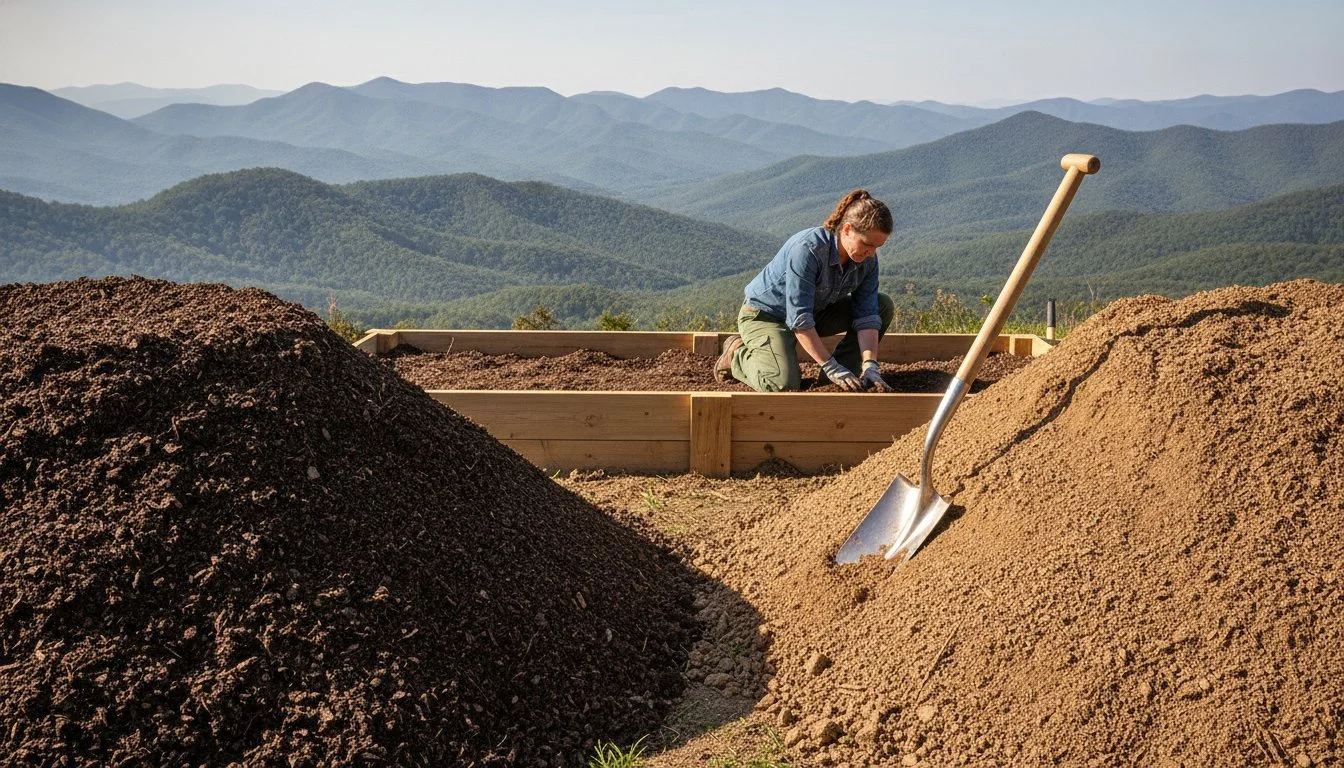
You might believe that any bag of dirt from a big-box store will fix the drainage issues in your backyard, but in the rocky, clay-heavy terrain of Watauga County, the wrong choice often leads to a costly failure. It's frustrating to spend hours digging through mica-rich soil only to have your plants struggle during the next heavy rain in the mountains. We understand that you need a reliable foundation that balances cost with performance, especially when you're dealing with the unique challenges of our 3,333-foot elevation and 53 inches of annual rainfall.
Deciding between topsoil vs compost for garden beds is the most critical decision you'll make this season. You want a productive vegetable patch or a vibrant flower garden, but you don't want to break the bank on individual bags for a large project. This guide provides a clear roadmap for building the perfect soil profile for the High Country. We will explain the structural differences between these materials, provide a cost-effective bulk delivery plan, and share the specific mixing ratios required to transform stubborn NC clay into a thriving ecosystem for your plants.
Key Takeaways
Identify the functional differences between mineral-based topsoil and nutrient-dense compost to ensure you provide the right biological fuel for your plants.
Utilize bulk topsoil as a cost-effective structural foundation for large-scale landscaping projects requiring reliable water retention.
Implement compost as a non-negotiable solution to break down heavy High Country clay and improve root-level aeration.
Determine the ideal ratio of topsoil vs compost for garden beds to prevent the issues associated with planting directly into "hot" organic matter.
Optimize your project timeline by leveraging professional bulk delivery services throughout Watauga, Avery, and Ashe Counties.
Defining the Soil Duo: What is Topsoil vs. Compost?
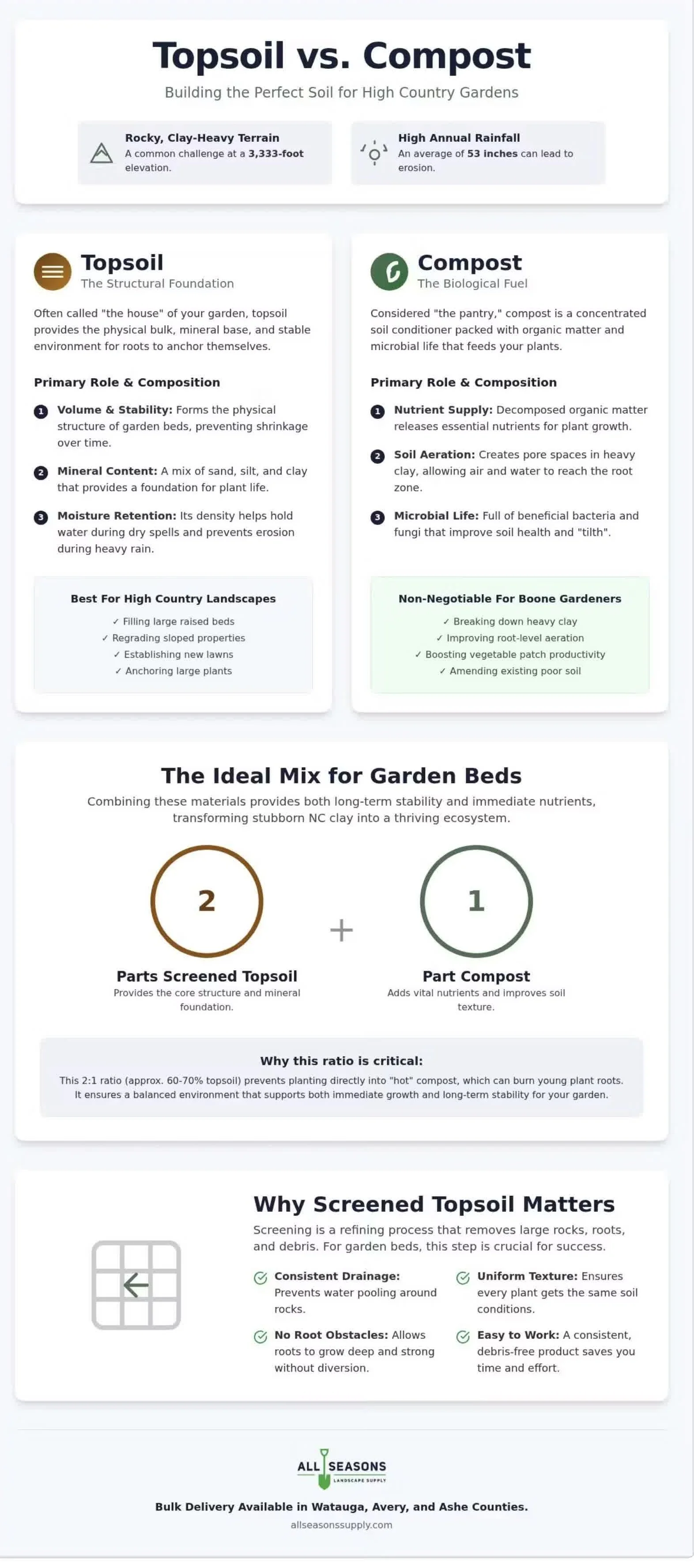
Successful gardening in the High Country requires a clear understanding of your raw materials. While many people use the terms interchangeably, topsoil and compost serve entirely different functions within a landscape. Topsoil serves as the earth's structural foundation, providing the physical bulk and mineral base necessary for stability. In contrast, compost is the nutrient-dense result of decomposed organic matter, acting as a biological fuel for plant growth. Choosing the right balance of topsoil vs compost for garden beds is the first step toward ensuring operational success in your outdoor space.
In North Carolina, where heavy clay and rocky terrain are the norms, using one material without the other often leads to failure. Topsoil provides the "house," but compost provides the "pantry." Without the mineral structure of topsoil, your garden beds will lack the density to hold moisture and support deep roots. Without the biological activity of compost, the native clay becomes compacted and impenetrable. They are a partnership designed to address specific soil challenges by combining physical stability with biological vitality.
Topsoil: The Anchor of Your Garden
Technically, "topsoil" refers to the uppermost layer of the earth's crust, usually the top five to ten inches. It's composed of a precise mix of sand, silt, and clay minerals, along with a small percentage of organic matter. Its primary role is to provide volume and structural support. High-quality topsoil provides root systems with a stable environment to anchor them against mountain winds and heavy rains. When sourcing topsoil near me, it's vital to choose a screened product. This process removes large rocks and debris, ensuring a consistent texture that is easy to work with and allows uniform water penetration throughout the bed.
Compost: The Biological Engine
Compost isn't "dirt" in the traditional sense; it's a concentrated soil conditioner. It's teeming with microbial life, including beneficial bacteria and fungi that break down nutrients, making them available to plant roots. This biological activity improves soil "tilth," the physical condition of the soil relative to its fitness for planting. For High Country gardeners, compost is the primary tool for improving aeration. It creates essential pore spaces in heavy clay, allowing air and water to reach the root zone. Because it is so concentrated, using the correct ratio of topsoil vs compost for garden beds prevents "burning" young plants with excessive nutrient levels while still providing the engine they need to thrive.
The Essential Role of Topsoil in High Country Landscapes
High Country projects often involve significant square footage, making bulk materials a logistical necessity. While compost provides the nutrients, topsoil provides the mass. Bulk topsoil is the most cost-effective solution for filling large raised beds or regrading sloped mountain properties. Without this mineral foundation, a bed filled only with organic matter would rapidly shrink as the material decomposes. By providing a stable mineral base, topsoil helps ensure your garden doesn't "disappear" over time. Determining the right ratio of topsoil vs compost for garden beds is a matter of long-term stability.
In our variable mountain weather, topsoil plays a vital role in moisture management. Boone receives approximately 53 inches of annual rainfall. This high volume of water can easily wash away lighter organic materials. Topsoil’s density helps retain water during dry spells while providing the weight necessary to stay in place during a storm. If you are searching for landscaping supplies near me, prioritizing high-quality topsoil is essential for grading and establishing new lawns.
Why Screened Topsoil Matters
Screened topsoil is a refined mineral base ideal for High Country planting. Unlike raw fill dirt, screened soil has been passed through a mesh to remove large rocks, roots, and debris. This process is crucial for garden beds because it ensures consistent drainage. Large rocks in the soil can create pockets where water pools or create obstacles that divert root growth. By using a uniform product, you ensure that every plant in your bed has access to the same soil conditions, which leads to a more predictable and successful harvest.
Topsoil for Structural Stability
Mountain gardening often means contending with high winds and steep inclines. Topsoil provides the structural stability that loose compost lacks. If you use a ratio that favors too much organic matter, larger plants like tomatoes or perennials may topple because their roots cannot find purchase in the fluffy material. While composting for home gardens is essential for soil health, the topsoil acts as the anchor. It holds the root ball firmly in place, allowing the plant to withstand the gusts common at our higher elevations.
Additionally, the mineral density of topsoil slows the rapid evaporation of moisture, keeping the root zone cooler and more hydrated during the peak of summer. When evaluating topsoil vs compost for garden beds, remember that the topsoil provides the permanent structure that organic amendments cannot match. Planning your project around reliable landscape supplies ensures your garden has the structural integrity it needs to flourish.
Why Compost is Non-Negotiable for Boone Gardeners
High Country gardeners face a specific challenge: heavy, red clay that often feels more like concrete than soil. While topsoil provides the necessary volume discussed earlier, compost is the functional agent that makes that volume productive. It is the primary solution for the drainage issues inherent to our region. By introducing organic matter, you create essential "pore space" within the soil structure. These microscopic gaps allow air and water to reach the roots, preventing the suffocating environment that often kills plants in untreated clay. Compost transforms a dense, stagnant base into a breathable medium.
High-quality organic compost also acts as a slow-release fertilizer. Unlike synthetic chemicals that can be washed away during our 53 inches of annual rainfall, the nutrients in compost remain bound to soil particles. This steady supply of nutrition is vital for supporting nursery plants in Blowing Rock during their critical first growing season. When evaluating topsoil vs. compost for garden beds, consider compost the essential amendment that activates the mineral foundation of your landscape.
Amending the Mountain Clay
Successful gardening in Watauga County requires managing the soil's cation exchange capacity (CEC). In simple terms, CEC is a measure of how well your soil can hold onto nutrients and "feed" them to your plants. Compost significantly increases this capacity. Without it, nutrients leach through the rocky terrain. Choosing a soil amendment like compost prevents clay from turning into hard, impenetrable "bricks" during the dry spells of late summer. For established beds, we recommend top-dressing with an inch of fresh compost annually to maintain this texture and nutrient level. This practice ensures your topsoil-to-compost ratio for garden beds remains balanced as organic matter naturally breaks down.
Microbial Life and Disease Suppression
Compost introduces a diverse community of beneficial fungi and bacteria that act as a biological shield for your garden. These microorganisms actively fight off plant pathogens that thrive in damp, poorly drained environments. This healthy soil biology also increases plant resilience against the sudden temperature swings common in our frost-prone region. A robust microbial population helps plants recover faster from environmental stress by ensuring they have immediate access to the resources they need. Compost turns inert dirt into a living ecosystem where vegetables and perennials can thrive despite the harsh mountain climate.
Topsoil vs. Compost: The Ultimate Comparison for Garden Beds
Choosing between these two materials involves balancing immediate performance with long-term stability. Topsoil offers the highest mineral density and the lowest cost per cubic yard, making it the standard choice for volume. Compost, while more expensive, provides the biological "kick" necessary for plant health. A common misconception among new gardeners is that planting directly into 100% compost will yield better results. In reality, pure compost can be "too hot" for young seedlings. The high salt concentration and active decomposition can burn delicate roots. Additionally, compost lacks the mineral weight to support larger plants, often leading to poor drainage as the organic matter settles and compacts.
The long-term behavior of these materials is the most significant differentiator. Topsoil is a permanent addition to your landscape. Once you level a yard or fill a bed, that mineral base remains. Compost is a temporary amendment. It "disappears" over time as microbes consume organic matter and plants take up nutrients from the soil. This cyclical nature means you must plan for regular replenishment. When evaluating topsoil vs compost for garden beds, think of topsoil as the investment in infrastructure and compost as the annual operating budget.
The 70/30 High Country Blend
For new garden beds in the Boone and Blowing Rock area, we recommend a specific ratio: 70% screened topsoil to 30% organic compost. This blend provides enough mineral structure to prevent settling while ensuring your plants have immediate access to nutrients. In our acidic, clay-heavy environment, this 70/30 split creates an ideal balance of drainage and fertility. To calculate your needs, multiply the square footage of your bed by the desired depth in feet, then divide by 27 to find the total cubic yards. Applying this formula ensures you order the correct volume from a dependable landscape supplier.
When to Choose One Over the Other
Specific project goals dictate which material should dominate your order. Topsoil is the correct choice for leveling uneven ground, filling deep raised beds, or establishing a base for new sod. It provides the heavy, mineral-rich environment that grass and large perennials require for stability. Use compost primarily to amend existing clay soil, top-dress vegetable rows, or backfill holes when planting shrubs. For deep raised beds, consider the "sandwich" method. Fill the bottom 60% of the bed with standard topsoil to provide volume at a lower cost, then use your premium 70/30 blend for the top layer where the roots are most active. This strategy maximizes your budget while providing a professional-grade growing environment. If you're ready to start your project, you can order bulk soil delivery to simplify the process.
Bulk Delivery Logistics in the High Country
Managing a large-scale gardening project requires more than just high-quality materials; it requires a coordinated logistical plan. While bagged products are convenient for small containers, they are inefficient and cost-prohibitive for filling substantial garden beds. A single cubic yard of soil is equivalent to approximately 27 standard bags from a retail store. By choosing bulk mulch or bulk soil delivery in Boone, NC, you significantly reduce the unit cost of your project. We provide reliable delivery services across Watauga, Avery, and Ashe Counties, ensuring your materials arrive on-site to maintain your project's momentum.
Our delivery process is designed to support the operational needs of homeowners and professional landscapers alike. Transporting heavy loads of topsoil vs compost for garden beds over mountain terrain requires specialized equipment and local experience. We view ourselves as your industrious partner, handling the heavy lifting so you can focus on the technical aspects of planting and grading. This professional approach to logistics ensures that your raw materials are handled with care and delivered according to your specific timeline.
Preparing for Your Soil Delivery
Preparing your property for a bulk delivery is essential, especially given the narrow driveways and steep inclines common in our region. We recommend marking your desired drop-off spot clearly with a stake or a cone. This prevents confusion and ensures the truck doesn't block essential access points. Before the truck arrives, check for overhead obstacles such as power lines or low-hanging tree branches that could interfere with the dumping mechanism.
Because the High Country receives approximately 53 inches of annual rainfall, weather protection is a priority. We advise having a heavy-duty tarp ready at the delivery site. Covering your pile immediately after delivery prevents the material from becoming waterlogged or washing away during a sudden mountain storm. This simple step keeps your soil manageable and ready for immediate use, regardless of the weather cycle.
The All Seasons Supply Difference
All Seasons Supply brings over 50 years of combined industry experience to every project. As a locally owned and operated company since 2019, we understand the nuances of High Country gardening. We don't just drop off dirt; we provide the expert consultation needed to navigate mountain-specific challenges. Our team maintains a steady, methodical rhythm in our communication and delivery, providing you with the peace of mind that your materials will be there when you need them. Whether you are still weighing the benefits of topsoil vs compost for garden beds or you are ready to fill several large raised beds, our local expertise is your greatest asset. Contact All Seasons Supply for expert soil advice and bulk delivery to ensure your next project has a dependable foundation.
Build a Resilient Foundation for Your High Country Garden
Successfully navigating the unique challenges of mountain gardening requires a strategic approach to soil health. You've learned that mineral-rich topsoil provides the necessary structural anchor, while organic compost serves as the biological engine to break down heavy clay. Balancing these elements ensures your plants have both the stability to withstand mountain winds and the nutrients to flourish during our shorter growing season. Finding the right ratio of topsoil vs compost for garden beds is the most effective way to guarantee long-term productivity without wasting resources on trial and error.
All Seasons Supply is ready to act as your industrious partner in this process. With over 50 years of combined landscaping and nursery experience, our family-owned team understands the logistical demands of Watauga, Avery, and Ashe Counties. We specialize in providing the raw materials you need to transform stubborn terrain into a thriving landscape. Get a Quote for Bulk Topsoil and Compost Delivery to secure the dependable foundation your garden deserves.
We look forward to helping you achieve a successful and sustainable growing season.
Frequently Asked Questions
Can I use 100% compost in my raised garden beds?
Using 100% compost is not recommended because the material is biologically "hot" and lacks mineral stability. It can burn young roots and will settle significantly as it decomposes. For the best results when using topsoil vs compost for garden beds, stick to a 70/30 ratio. This provides the structural foundation your plants need while delivering a safe, steady supply of nutrients throughout the growing season.
How much topsoil and compost do I need for a 4x8 raised bed?
A standard 4x8 raised bed filled to a depth of 12 inches requires approximately 1.2 cubic yards of material. To achieve our recommended High Country blend, you would need about 0.85 cubic yards of screened topsoil and 0.35 cubic yards of compost. Ordering in bulk ensures you have enough material to account for natural settling after the first heavy rainfall, which is common in our region.
Will topsoil from All Seasons Supply contain weeds?
Our screened topsoil is processed to remove large debris and rocks, but no natural soil is completely sterile. While the screening process significantly reduces the presence of established root systems, dormant seeds can occasionally travel via wind or birds. We recommend applying a layer of mulch or pine straw immediately after planting to suppress any opportunistic growth and maintain a clean, professional garden environment.
Is it better to buy soil in bags or in bulk for a Boone garden?
Bulk delivery is the superior choice for any project larger than a few small containers. One cubic yard of bulk soil replaces 27 standard bags, saving you significant money and manual labor. For a Boone garden, bulk materials also eliminate the plastic waste associated with retail products. Our delivery service ensures your materials arrive exactly where you need them on your property, ready for immediate use.
What is the difference between potting soil and topsoil?
Potting soil is a lightweight, soilless medium designed for containers, often containing peat moss and perlite for maximum drainage. Topsoil is a heavy, mineral-based material meant for ground-level beds and landscaping. Using topsoil in a pot will cause compaction and root rot. Conversely, using potting soil in a large garden bed is prohibitively expensive and lacks the mineral density that plants need for long-term structural stability.
Does compost attract pests to my garden in the High Country?
Finished, high-quality compost does not attract pests. Problems usually arise from unfinished compost that contains active food scraps. The professional-grade compost we provide is fully decomposed and stable, making it unattractive to wildlife. It actually supports beneficial microorganisms that improve soil health. Maintaining a clean garden perimeter is the most effective way to manage local pest populations regardless of your soil choice.
How often should I add fresh compost to my garden beds?
You should add a fresh layer of compost to your garden beds once per year, typically in the early spring or late fall. Top-dressing with one to two inches of organic matter replenishes the nutrients that your plants consumed during the previous season. This annual maintenance keeps the topsoil-to-compost ratio for garden beds balanced as the older organic matter naturally integrates into the mineral base of your soil.
Does All Seasons Supply deliver to Banner Elk and Beech Mountain?
Yes, All Seasons Supply provides bulk delivery to Banner Elk, Beech Mountain, and the surrounding areas. We regularly serve clients across Watauga, Avery, and Ashe Counties. Our drivers are experienced with the steep inclines and narrow roads characteristic of these mountain communities. We coordinate with you to ensure a safe and efficient drop-off that respects your property's specific logistical constraints and operational needs.